
- Introduction
- Moral Philosophy: A Definition
- Conclusion
When people ask me about Morality in the age of AI, specially making blatant statements about what is considered right or wrong, I usually show them this. I cannot remember the source of this table or if it was compiled over time in my endless notes, but it serves me as a reminder of how complicated it might get to answer the, usually perceived as simple, question of defining an action or behaviour as moral/ethical or not.
Ethics (Moral Philosophy)
├── 1  Meta-Ethics ← What is morality?
│   ├── 1.1  Moral Realism / Objective Morality
│   │   ├── 1.1.1  Naturalistic Realism (Moral Naturalism)
│   │   ├── 1.1.2  Non-Naturalistic Realism
│   │   ├── 1.1.3  Theistic Moral Realism
│   │   └── 1.1.4  Value-Pluralism / Plural Realism
│   ├── 1.2  Moral Anti-Realism
│   │   ├── 1.2.1  Non-Cognitivism
│   │   │   ├── Emotivism
│   │   │   ├── Expressivism / Quasi-Realism
│   │   │   └── Prescriptivism (Hare)
│   │   ├── 1.2.2  Cognitivist Anti-Realism
│   │   │   └── Error Theory (Mackie)
│   │   └── 1.2.3  Subjectivism / Relativism
│   │       ├── Individual Subjectivism
│   │       └── Cultural Relativism
│   ├── 1.3  Moral Constructivism
│   └── 1.4  Moral Skepticism (suspension of judgement)
│
├── 2  Normative Ethics ← Which principles make actions right or wrong?
│   ├── 2.1  Deontological Theories (duty-centred)
│   │   ├── 2.1.1  Divine Command Theory
│   │   │   ├── 2.1.1.1  Strong / Voluntarist
│   │   │   ├── 2.1.1.2  Modified (Loving-God) Version
│   │   │   └── 2.1.1.3  Intellectualist / Co-extensive Version
│   │   ├── 2.1.2  Kantian Deontology
│   │   ├── 2.1.3  Rossian Plural Duties
│   │   └── 2.1.4  Natural-Law Ethics
│   ├── 2.2  Consequentialist Theories (outcome-centred)
│   │   ├── 2.2.1  Utilitarianism
│   │   │   ├── Classical (Hedonistic)
│   │   │   ├── Preference
│   │   │   ├── Act
│   │   │   └── Rule
│   │   ├── 2.2.2  Negative Utilitarianism
│   │   ├── 2.2.3  Agent-Relative Teleological (Ethical Egoism)
│   │   └── 2.2.4  Ideal-Observer Theory
│   ├── 2.3  Virtue Ethics (character-centred)
│   │   ├── Aristotelian
│   │   ├── Stoic
│   │   ├── Confucian
│   │   ├── Thomistic
│   │   └── Buddhist
│   ├── 2.4  Contractualism / Contractarianism
│   │   ├── Hobbesian Contractarianism
│   │   └── Scanlonian Contractualism
│   ├── 2.5  Ethics of Care
│   ├── 2.6  Pragmatist / Pragmatic Ethics
│   ├── 2.7  Moral Particularism
│   └── 2.8  Pluralistic / Hybrid Theories
│
└── 3  Applied Ethics ← How do those principles guide real-world issues?
    ├── 3.1  Biomedical & Health-Care Ethics
    │   ├── Clinical Ethics
    │   └── Research Ethics
    ├── 3.2  Environmental Ethics
    │   ├── Deep Ecology
    │   └── Ecofeminism
    ├── 3.3  Animal Ethics
    ├── 3.4  Professional & Business Ethics
    │   ├── Accounting / Finance Ethics
    │   ├── Marketing Ethics
    │   └── Engineering, Legal, Journalism Ethics
    ├── 3.5  Technology & AI Ethics
    ├── 3.6  Media & Communication Ethics
    ├── 3.7  Legal & Criminal-Justice Ethics
    ├── 3.8  Political Ethics & Public Policy
    ├── 3.9  Military Ethics & Just-War Theory
    ├── 3.10  Gender, Sexuality & Family Ethics
    └── 3.11  Sports & Entertainment Ethics
Notice there is nothing here that mentions AI, yet, except in one branch. Unfortunately though, we cannot understand that branch until we have established a strong understanding of the overarching branches and schools, if nothing else, then at least for the sake of comparison.
Introduction
What is morality, and how should we think about ethical decisions? These age-old questions form the basis of moral philosophy (also known as ethics). Moral philosophy provides a framework for understanding right and wrong – a foundation that is increasingly crucial in the age of artificial intelligence. As AI systems become more advanced and integrated into society, developers and users alike must grapple with ethical questions: How should an autonomous car make life-and-death decisions? Should an AI assistant follow all instructions it’s given? By exploring moral philosophy, we equip ourselves with concepts and principles to thoughtfully address such questions. This introductory post sets the stage by mapping out the major branches of moral philosophy and defining key terms. Understanding these branches will give AI practitioners and general readers a common language and toolkit for the ethical discussions to come.
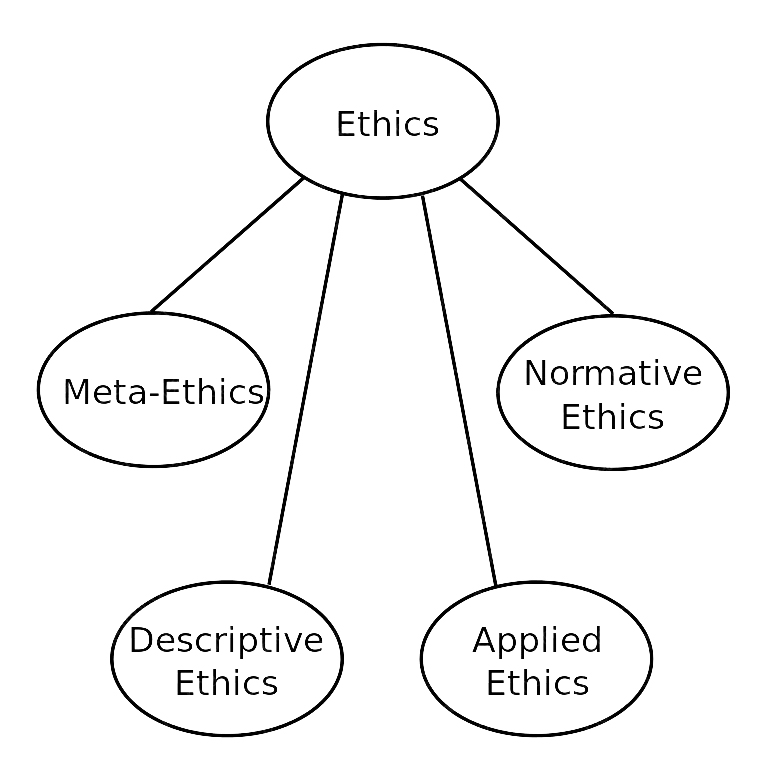
An illustrative “ethics tree” diagram showing the main branches of ethics. Classical moral philosophy is commonly divided into Meta-Ethics, Normative Ethics, and Applied Ethics (with Descriptive Ethics sometimes identified as a separate branch focusing on how people actually behave). Each branch of the ethics tree addresses a different dimension of moral inquiry, as outlined below.
Moral Philosophy: A Definition
Moral philosophy, or ethics, is the branch of philosophy that examines questions of right and wrong, good and evil, virtue and vice. It asks “How ought we to live, and why?” Ethics is traditionally divided into three broad domains: meta-ethics, normative ethics, and applied ethics. Each of these domains contains numerous sub-branches and theories, creating an expansive “moral philosophy tree” of ideas. In this paper, we explore every major branch and sub-branch of that tree, following a structured breakdown of categories and subcategories. The discussion is organized into three main sections corresponding to the three domains. Each section defines the domain, then elaborates on each sub-branch in detail with definitions, key ideas, and practical examples.
Meta-Ethics
Meta-ethics is the foundation of moral philosophy, concerned not with what actions are right or wrong, but with more abstract questions about morality itself. It examines the meaning of moral language, the nature of moral facts or values, and how (or if) we can know moral truths. In other words, while normative ethics and applied ethics deal with what is moral, meta-ethics asks what morality is. For example, if two people disagree on whether an action is ethical, meta-ethics steps back and asks: What do we mean by “ethical”? Are there objective facts about right and wrong, or are moral values subjective? How can we justify or know any moral claim? Meta-ethical inquiry is highly abstract and often called “second-order” moral theorizing (since it analyzes the assumptions behind our first-order ethical judgments).
Key questions in meta-ethics include:
- Meaning: What do words like .“good,” “wrong,” or “duty” really mean? When someone says “Kindness is good,” are they stating a fact, expressing a feeling, or something else?
- Ontology: Do moral properties (like goodness or wrongness) exist independently out in the world? Are they part of reality (like physical properties), or are they human creations, or illusions?
- Epistemology: If moral truths exist, how can we know them? Through reason, intuition, divine revelation, or cultural consensus?
- Psychology and motivation: Why do moral judgments influence our behavior? Does saying “Stealing is wrong” carry any motivation by itself, or do we need a desire to be moral for it to matter?
Meta-ethical theories offer differing answers. The major branches of meta-ethics can be mapped according to two primary axes:
- Moral Objectivity: Are there objective moral facts (true regardless of human opinion)? The moral realism vs. anti-realism debate centers on this. Moral realists say yes, there are objective truths about right and wrong. Anti-realists say no, morality is not objectively factual in that way (it may be subjective, relative, or entirely fictitious).
- Cognitive Meaning: Do moral statements express truth-apt beliefs that can be true or false, or do they express non-factual attitudes? This is the divide between cognitivism (moral language expresses beliefs/propositions) and non-cognitivism (moral language expresses feelings, commands, or attitudes, not truth-claims).
Using these distinctions, we can outline the sub-branches of meta-ethics as follows:

Moral Realism (Moral Objectivism)
Moral realism holds that there are objective moral facts or truths – moral values exist independently of our beliefs or perceptions. In this view, when we say “Honesty is good” or “Murder is wrong,” we are describing real features of the world (not just our opinions). A moral realist believes statements like “Charity is morally right” can be true or false in an objective sense, much as statements about the natural world can be true or false. Moral realism is often associated with moral objectivism, the idea that some moral principles hold universally, for everyone.
However, moral realists differ on what exactly these objective moral facts are and how they exist. Two important sub-branches of moral realism are ethical naturalism and ethical non-naturalism.
Ethical Naturalism
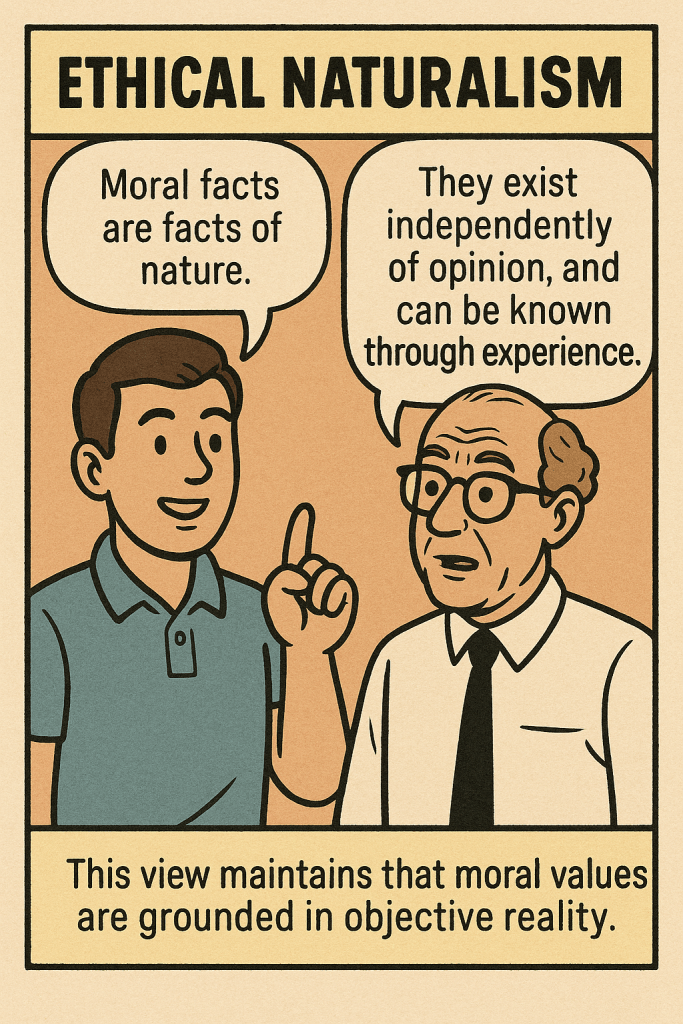
Ethical naturalism (or moral naturalism) is the realist view that moral facts are essentially natural facts – part of the natural world and accessible through empirical observation or science. In other words, moral properties like “good” or “evil” are reducible to or constituted by natural properties (such as pleasure or pain, human flourishing, preferences, biological needs, etc.). Moral truths can thus be studied and known in largely the same ways we discover scientific truths. For example, a naturalist might say “Goodness is just whatever promotes human well-being” – defining the moral in terms of a natural quality (health, happiness, survival, etc.). If so, one could investigate empirically which actions increase well-being to determine what is morally right.
This position treats ethics as continuous with science and reason. Many ethical naturalists argue that moral judgments can be verified or confirmed by evidence (for instance, data about what causes happiness or social stability). Classical utilitarianism is often considered a form of naturalism: it equates “good” with pleasure or happiness (a natural psychological state) and uses observation (of consequences) to judge right actions. Aristotelian virtue ethics can also be seen as naturalistic in grounding virtue in human nature and what causes humans to flourish. Modern thinkers have even proposed a “science of morality” to empirically understand how to maximize wellbeing.
Example (Ethical Naturalism): A naturalist might argue that kindness is morally good because it tends to increase overall social cooperation and personal happiness (observable outcomes). Since these outcomes benefit human well-being – a natural fact – kindness derives its moral value from that natural property. Thus, “Kindness is good” could be tested by studying its effects on communities.
One challenge to ethical naturalism is G.E. Moore’s Open Question Argument (1903). Moore pointed out that no matter how you define “good” in natural terms (say, as “pleasure”), it always remains an open, meaningful question: “Yes, pleasure is nice, but is pleasure really good?” The fact that such a question makes sense suggests that “good” might not be reducible to any specific natural property – implying a gap between facts and values. This critique led Moore and others to favor non-naturalism.
Ethical Non-Naturalism

Ethical non-naturalism is the realist stance that moral facts are real and objective, but not reducible to natural facts. On this view, moral properties are a unique kind of thing – irreducible and perhaps knowable through intuition or rational insight rather than observation. Non-naturalists often consider moral truths as abstract, more like mathematical truths or Plato’s Forms: real in a philosophically robust sense, but not physical. For example, a non-naturalist might say “Justice” or “goodness” are fundamental aspects of reality, not identifiable with any empirical phenomenon, but nonetheless objectively existing.
Philosopher G.E. Moore himself argued that “Good” is a simple, indefinable quality – we can’t break it down into natural terms without a loss of meaning. This view is sometimes called moral Platonism or intuitionism: moral knowledge comes via rational intuition of self-evident truths. Early 20th-century intuitionists (Moore, W.D. Ross) held that we directly “see” certain acts as right or wrong by a kind of moral insight, just as we might grasp a mathematical axiom. These truths (e.g. “Hurting others for no reason is wrong”) don’t derive from natural science, but we recognize them as objectively valid.
Non-naturalist moral realism emphasizes the sui generis (of its own kind) nature of ethics. Moral facts exist, but they are special – not observable like gravity, yet not mere subjective opinions. This position can appeal to those who feel morality has a weighty, universal authority that can’t be explained away as just natural preference. However, it faces the challenge of explaining what moral facts are if not natural, and how we access them. Critics have called non-natural properties “queer” or ontologically strange, raising what philosopher J.L. Mackie termed the “argument from queerness” against objective values.
Example (Ethical Non-Naturalism): A non-naturalist might argue that courage is a virtue in and of itself, not because of any measurable outcomes it produces, but because we intuitively recognize the value of bravery. Even if an act of courage leads to negative consequences, we might still honor it as morally good – suggesting the goodness lies in the act’s character (an abstract quality), not in empirical results.
Theistic Moral Realism: Some moral realists (like me) ground moral facts in a divine source – for instance, God’s commands or nature. If one believes God’s will defines objective morality, then moral truths exist independently of human minds (in God’s mind or character). This can be seen as a form of moral realism (moral facts are real because God guarantees them). It overlaps with normative Divine Command Theory , but at the meta-ethical level it asserts an ontological foundation: “Good” exists as an aspect of God or as ordained by God. This raises its own puzzles (see the Euthyphro dilemma: Is something good because God commands it, or does God command it because it is good?). Theistic realists typically answer that God’s perfectly good nature defines goodness objectively.
Moral Relativism and Subjectivism
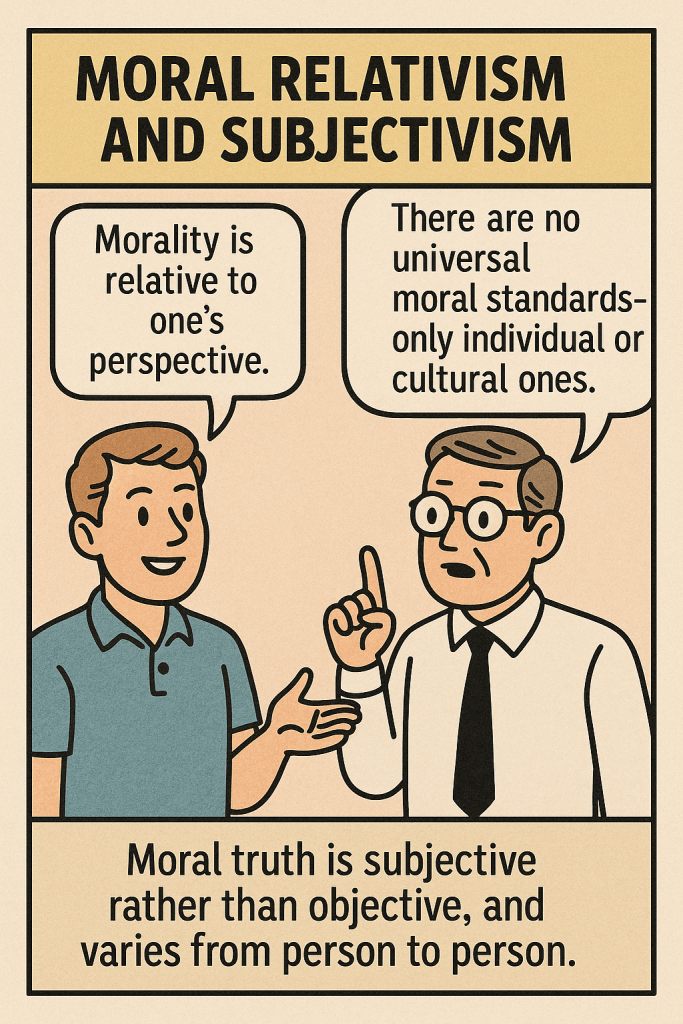
On the opposite side of realism stands moral anti-realism, which encompasses several views that deny objective, independent moral facts. Foremost among these are moral relativism and moral subjectivism. These theories hold that morality is human-dependent – created by human minds, societies, or cultures – rather than an external truth. According to relativists and subjectivists, moral judgments can be true or false only relative to some standpoint (a culture, society, historical period, or individual), and there is no uniquely correct standpoint that overrides all others. In short, morality is a human construct.
- Moral relativism usually refers to cultural relativism: the idea that what is morally right or wrong depends on the norms, values, or beliefs of a particular culture or society. There are no universally valid moral principles, only culturally bounded ones. For example, a practice deemed wrong in one society (say, polygamy or alcohol consumption) might be morally permissible in another; and there is no objective fact of the matter beyond those social standards. Moral truth is relative to culture: an action is right for a society if it coheres with that society’s moral framework. Relativists often emphasize the anthropological observation that different societies have radically different moral codes, and they argue we should avoid ethnocentric judgment. They also contend that no culture’s values are objectively superior – we have to judge each practice within its context.
- Moral subjectivism is a closely related position at the individual level: it holds that morality is ultimately a matter of personal attitudes or opinions. A moral claim like “Charity is good” simply means “I approve of charity” or “My values endorse charity.” There is no fact of the matter beyond individuals’ sentiments. In subjectivism, each person in effect has their own moral truth. This view implies that when individuals disagree morally, they’re not debating an objective truth but merely expressing different personal standpoints. (For example, if Alice says lying is wrong and Bob says it’s not always wrong, each is stating their own stance; neither is “objectively” correct or incorrect.)
In practice, “moral relativism” is often used broadly to cover both cultural and individual dependency of morality. The core idea is that moral standards are not absolute: they are created by humans and can vary. Relativists typically deny that any moral principle (even basic ones against harm or dishonesty) holds universally for all people at all times. They also argue that tolerance of other cultures’ values is a virtue, since without objective truth, we should avoid condemning moral practices that differ from our own.
Example (Cultural Relativism): In Society A, eating animals might be considered morally wrong due to religious belief in the sanctity of all life. In Society B, eating animals is morally acceptable and part of traditional cuisine. A cultural relativist would say there is no absolute moral rule about eating animals – it is wrong in Society A (according to A’s standards) but not wrong in Society B (according to B’s standards). And we, observing from outside, cannot declare one society “correct” and the other “mistaken” morally, since each is right by its own moral framework.
Example (Subjectivism): An individual subjectivist might say “Generosity is good means nothing more than I like generosity.” If another person says “I think generosity is foolish,” then generosity is “good” for the first person and “not good” for the second, and that’s the end of it. Moral discourse becomes a description of personal preferences, not a search for universal truths.
Under moral relativism/subjectivism, moral disagreements are often seen as ultimately unresolvable by reason, because each party may just be coming from a different framework. This has led critics to charge relativism with promoting a problematic tolerance for “anything goes.” If every culture’s or person’s values are equally valid, does that mean we cannot criticize horrific practices (like slavery or genocide) in other societies as wrong? Relativists respond that they can still object on grounds of their own values, but they acknowledge no Archimedean point outside all value systems from which to pronounce final judgment. Some relativists (e.g. philosopher David Wong) attempt to find a middle path: recognizing a plurality of moral values that are grounded in human nature broadly (so not an anything-goes free-for-all), yet allowing that different societies rightfully prioritize different values within some constraints.
It’s worth noting that meta-ethical relativism as described here is a claim about truth of moral judgments (they have truth relative to standards). This is different from merely describing that people’s beliefs differ (that’s descriptive cultural relativism, a sociological fact). Meta-ethical relativism asserts no independent moral facts beyond those relative standards.
Moral Nihilism (Error Theory)

Moral nihilism is an even more radical form of moral anti-realism. The term “nihilism” implies a belief in “nothing” (nihil). In ethics, moral nihilism is the view that there are no moral truths at all – no right or wrong, no good or evil, in any objective sense. If moral relativists say “moral truth exists, but it’s relative to standpoints,” nihilists go further to say no standpoint makes moral statements true, because morality itself is a kind of fiction or illusion. All moral claims are, at best, false statements (since they purport to describe a non-existent moral reality) or meaningless expressions with no truth value.
A leading form of moral nihilism is error theory, championed by philosopher J.L. Mackie. Error theory is so named because it says that all moral judgments are in error: whenever people make moral claims (“It’s wrong to cheat,” “We ought to help the poor”), they are talking as if there were objective moral facts – but since no such facts exist, all those claims are systematically false. According to Mackie, our ordinary moral discourse presupposes objectivity (we behave as if some actions really have the property of wrongness), and thus we’re always committing an error in judgment, attributing properties that nothing actually has.
In simpler terms, the error theorist agrees with the moral realist that moral language aims at stating truths, but asserts that no moral statement is ever true, because the world contains no moral features to make them true. This position combines cognitivism (moral statements do express propositions) with a stark form of anti-realism (all those propositions are false). It’s akin to saying: moral discourse is like talk about phlogiston or witches – people might earnestly discuss them, but those referents simply aren’t real, so all such statements are false or ungrounded.
Another variant of nihilism is sometimes called moral fictionalism – the idea that while moral claims aren’t true, it might be useful to engage in moral talk as a convenient fiction (some philosophers explore this as a way to live with nihilism without throwing out moral practice entirely).
Moral nihilism in practice: A nihilist would contend that saying “Murder is wrong” is not stating a truth, since “wrongness” doesn’t objectively exist. It’s as if one said “Murder is gloob” – if “gloob” is a non-existent property, the sentence has no truth. A committed nihilist might still dislike murder or prevent it, but they wouldn’t claim any moral fact makes murder wrong (they might cite practical or emotional reasons instead). In the extreme, a nihilist could conclude that since nothing is truly right or wrong, any action is permissible – though in reality many nihilists personally adhere to ethical codes for non-moral reasons (like preferences or social contracts).
Moral nihilism can sound alarming – the idea that “morality does not exist” – and it faces strong opposition. Critics argue that nihilism cannot account for the deeply felt experience of moral obligation or the interpersonal function of morality. If truly nothing mattered, why live or act at all? Nihilists respond that one can live by subjective values, or that morality might simply be a human invention (useful or not). Some also point out that nihilism doesn’t necessarily lead to immoral behavior – a person could disbelieve in objective morality yet decide to act kindly out of personal desire or aesthetic choice, rather than duty.
Nonetheless, the specter of “anything goes” often haunts discussions of nihilism. Without belief in any moral facts, what stops someone from doing awful things? Philosophically, nihilism remains a challenge: it asks whether all our moralizing is built on a grand illusion. Mackie, for instance, argued we have objective reasons to reject belief in objective values (such as their “queer” metaphysical nature and the observation of cultural variability). Thus, he concluded, it’s more plausible that our moral assertions are all false than that there exist objective values of the extraordinary type required.
In summary, moral nihilism/error theory represents the denial of morality’s reality. It is a minority view (most philosophers try to salvage some form of moral truth or at least function), but it is important as a consistent position that tests the assumptions of all others.
Reality Check: It’s worth noting that even among anti-realists, not all embrace full nihilism. Some (like relativists or subjectivists) believe moral claims can still be “true” relative to a person or culture. And non-cognitivists (next section) avoid error theory by saying moral statements aren’t even in the business of truth – thus they can’t be false if they’re not truth-apt to begin with. Nihilism remains the harshest meta-ethical verdict: the entire moral enterprise lacks truth or foundation. As one summary puts it, moral nihilism holds that moral judgments have no objective validity or truth-value – morality, therefore, does not exist in any real sense.
Moral Non-Cognitivism (Emotivism and Prescriptivism)

So far, we’ve considered theories (realism, relativism, nihilism) that generally agree moral statements purport to describe facts – they just disagree on what facts exist. Now we turn to non-cognitivist theories, which take a different approach: they claim that moral language does not even attempt to state truths. In other words, when we make moral statements, we are not expressing beliefs that can be true or false (thus non-cognitive), but rather doing something else – like venting emotions, issuing commands, or prescribing behavior.
Under non-cognitivism, the whole question of moral truth is misplaced, because moral sentences “lack truth-values” by their very nature. This perspective emerged in the 20th century with the rise of logical positivism and analytic philosophy’s focus on language. If moral statements aren’t factual claims, then disagreements in morals are not clashes of beliefs but perhaps conflicts of attitudes or imperatives.
Two classic non-cognitivist theories are emotivism and prescriptivism:
Emotivism (the “Boo/Hurrah” theory)
Emotivism asserts that moral judgments are expressions of emotion or attitude, not statements of fact. When you say “Stealing is wrong,” according to emotivism you are not describing stealing; you are effectively saying “Stealing – boo!” – expressing disapproval of it. Conversely, saying “Charity is good” equates to “Charity – hooray!” – cheering for it. This is why emotivism is often nicknamed the “boo/hurrah theory” of ethics.
A.J. Ayer and C.L. Stevenson were early proponents of emotivism. Ayer argued that moral language simply evinces our feelings and perhaps tries to influence others to share those feelings. Under emotivism, moral sentences are not truth-apt: they’re more like exclamations or interjections. For example, shouting “That’s wrong!” in response to a theft is akin to shouting “Boo, theft!” – an emotional exclamation of condemnation. Such utterances can’t be true or false; they just show the speaker’s attitudes (and perhaps aim to arouse similar attitudes in listeners).
Emotivism can explain why moral debates often have a persuasive, motivational aspect – we’re not just trading facts, we’re trying to influence others’ attitudes. It also fits with the observation that someone might sincerely say “X is wrong” without any evidence, purely from sentiment. According to emotivists, that’s fine because no evidence is needed for an expression of feeling.
Example (Emotivism): Take the statement “Helping a stranger in need is good.” If Alice is an emotivist, what she means by this is essentially “Helping a stranger – yay!” (an expression of approval and perhaps a recommendation: “I approve of helping; you should too!”). Bob might reply, “Letting strangers fend for themselves is good,” which on emotivism would be “Helping strangers – boo, I disapprove.” They are not factually contradicting each other, but expressing opposite attitudes. Their argument is more like a clash of cheerleading for different values than a disagreement about facts. To resolve it, they’d have to influence each other’s feelings, not point to factual evidence.
Prescriptivism
Prescriptivism, developed by R.M. Hare, proposes that moral statements are essentially imperatives or prescriptions – a kind of universalized command. According to Hare, when we say “You ought to do X,” we are not describing a fact but prescribing an action in a way that we commit to being universal (if anyone is in similar circumstances, they ought to do X too).
Thus, “Stealing is wrong” can be interpreted as “Do not steal,” said in a universal prescriptive voice – you are instructing both yourself and others not to steal. Unlike a mere personal command, a moral prescription carries a sense of generality (for anyone relevantly similar) and overriding importance. But crucially, it’s still not truth-apt; it’s more akin to advice or a rule one is laying down.
Hare’s idea was that moral language guides behavior by prescribing rather than describing. It also has a universalizability component: if I say “Lying is wrong (so I shouldn’t lie now),” I am logically committed to saying anyone in a similar situation also shouldn’t lie. This attempt to build logical consistency into moral discourse distinguishes prescriptivism from simple emotivism while maintaining non-cognitivism.
Example (Prescriptivism): If a doctor says to a medical student, “Doctors ought to respect patient confidentiality,” prescriptivism treats this as a prescription: “Any doctor, be sure to keep patient information private.” It’s like a rule or imperative: “Let all doctors respect confidentiality.” This isn’t a factual claim about doctors in the world; it’s a normative directive that the speaker endorses universally. If the student accepts it, they are adopting a commitment to act accordingly.
Implications of Non-Cognitivism: Under non-cognitivism, since moral statements aren’t truth-claims, moral disagreements are not about who’s right or wrong factually, but rather conflicts in attitude or commitments. An emotivist sees moral debate as attempting to influence others’ attitudes (“I boo X, you hooray X – can I persuade you to boo it too?”). A prescriptivist sees it as discussing which prescriptions we can will universally. These theories also elegantly explain the motivational force of morals: if saying “X is wrong” is akin to urging “Don’t do X,” it makes sense that if you sincerely utter that, you’re motivated not to do X. (This addresses the philosophical puzzle of why moral judgments motivate action – something cognitivist realists often debate via internalist vs externalist accounts.)
Non-cognitivism faces some challenges: logical problems like the Frege-Geach problem (how to account for moral statements in complex sentences and arguments if they’re not truth-apt). For instance, consider the statement: “If stealing is wrong, then encouraging your brother to steal is wrong.” In non-cognitivist terms, “Stealing is wrong” might be “Stealing, boo!” – but how do we understand an if-then construction with a non-propositional component? Non-cognitivists have worked out sophisticated responses (e.g., Simon Blackburn’s quasi-realism and Allan Gibbard’s norm-expressivism) to handle such issues, effectively mimicking truth conditions for moral language within a non-factual framework.
Another challenge is that many people intuitively feel moral judgments do aim at truth (“It’s really wrong to harm the innocent” sounds like a truth claim, not just “I dislike harming innocents”). Non-cognitivists must explain this intuition away as an aspect of how we use language (quasi-realists, for example, argue we project attitudes as if they were facts).
Quasi-Realism: As a side note, philosopher Simon Blackburn’s quasi-realism is an interesting development within non-cognitivism. It seeks to show that even if our moral statements are fundamentally expressions of attitude, we can still make sense of why we talk as if there are moral truths and even have a kind of “moral knowledge.” Quasi-realists claim we can earn the right to treat moral claims as true or false in practice, without positing objective moral facts – in effect, to have the advantages of realism without the metaphysical baggage, by understanding truth as relative to our moral attitudes under idealized conditions.
Moral Constructivism

Moral constructivism occupies something of a middle ground in meta-ethics. It agrees with anti-realism that there are no mind-independent moral truths “out there” in the world; however, it also agrees with realism (and cognitivism) that moral claims can be truth-apt and subject to rational assessment. The twist is that, according to constructivism, moral truths are “constructed” by some procedure or standpoint rather than discovered as independent facts.
In a constructivist view, morality is like a human construction project – we (either individually or collectively) construct valid moral principles through a certain process (often a rational deliberation procedure), and those principles are objectively binding given that we have committed to the process. The end result is not arbitrary: it is constrained by the procedure and by facts about human nature or reasoning. But prior to the construction, there were no moral facts.
Constructivism often comes in a Kantian flavor. For example, philosopher Immanuel Kant (as interpreted by some) can be seen as a constructivist: he argued that rational agents, through the exercise of practical reason and the requirement of universalizability (the Categorical Imperative), effectively construct the moral law. Christine Korsgaard, a modern Kantian constructivist, says that moral principles are the results of “constitutive” acts of willing by rational agents – they are not discoveries but decisions that any rational being must make to govern itself. Yet, because all rational beings share certain fundamental conditions, the constructed principles have a kind of universal force.
Another form of constructivism is found in social contract theory (overlapping with a normative theory we will discuss in section 2.4). For example, John Rawls’s approach in A Theory of Justice (1971) can be viewed as constructivist: he sets up a hypothetical fair bargaining scenario (the “veil of ignorance”) and argues that whatever principles would be agreed upon there are the just principles. Justice is not something we find in nature, but something that emerges from a fair agreement – a construction by agents who impose rules on themselves for mutual benefit. Those constructed principles (like equal basic liberties, or fair equality of opportunity) then become normative truths for that society. Rawls explicitly called his view “justice as fairness” a form of political constructivism.
Similarly, T.M. Scanlon’s contractualism (what we could hypothetically not reasonably reject) is a constructivist-like criterion for moral rightness. Rather than appeal to any independent moral order or utility calculations, Scanlon says an act is wrong if it would be disallowed by principles that no one could reasonably reject – essentially, morality comes from an idealized social agreement among equals.
Divine command theory can even be interpreted in a constructivist way: morality is constructed by God’s will or commands. That is, what is right or wrong is determined by God’s stipulation (not by God detecting independent moral facts). In the context of meta-ethics, that would mean moral truth is not independent of persons (here, the person is God), but is constructed by a perspective – albeit a divine one. Some consider this a theological subjectivism. For example, philosopher Robert Adams argues that ethical wrongness is based on disagreement with God’s loving nature/commands – thus moral facts exist (whatever a loving God commands), but they exist because of a stance (God’s). This ties into anti-realism in that without God, there’d be no moral facts; with God, there are facts but they are response-dependent on God’s attitudes.
To illustrate constructivism in a simple way: imagine morality as a game where we collectively agree on the rules. Before we agree, there are no “rules” – it’s not inherently wrong or right to do anything. But we, wanting to live together, might construct rules like “don’t harm each other” and “keep promises” because these follow from principles everyone could accept or from the very idea of treating people as equals. Once constructed, these rules become the moral facts for us. They are not arbitrary, because the construction follows rational criteria (like fairness or universalizability), and they are binding because any rational participant in our moral community would acknowledge them. They are objective given our adherence to the constructive procedure, but they are not objective in the sense of existing outside of any perspective.
Moral constructivism thus bridges subjective foundations and objective outcomes. It says, in effect, if you want to be a rational (or reasonable) agent, you must commit to certain normative standards – you “make” them true by committing to them under the proper conditions.
Example (Constructivism): Suppose we want to determine a fair principle for distributing resources in a society. A constructivist approach might have us imagine we’re choosing principles behind a veil of ignorance (not knowing our own position in society). Through that impartial reasoning process, we “construct” the principle that everyone should have equal basic opportunities. That principle wasn’t a pre-existing moral truth etched in the universe; it is the result of a construction procedure. Yet, once derived, it functions as a moral truth for that society: “Equality of opportunity is a just principle” becomes true within the constructed moral framework, and it guides action and critique of institutions.
Constructivism avoids the metaphysical “queerness” of non-natural realism (no strange entities – just humans reasoning), and it provides more normative guidance than plain relativism or nihilism (since not any construction goes – only those meeting rational criteria). However, critics question whether constructivism just collapses into either relativism (if different groups construct different morals, are they all equally valid?) or smuggles in realism (if the criteria for construction – e.g., rationality – end up yielding the same results any rational being must acknowledge, isn’t that effectively an objective truth?). Constructivists reply that their view is distinct: truths are procedural or constituted by agents, not “out there” beforehand, but also not purely subjective whim.
In summary, meta-ethical constructivism posits that moral principles are neither discovered nor arbitrary, but invented or agreed upon through a rational process. It captures a sense in which we create our moral world – but, ideally, we do so in a disciplined, reason-governed way that others could recognize as valid.
Recap of Meta-Ethics: Main Positions
- Realists say moral truths are objective facts (natural or non-natural).
- Relativists/Subjectivists say moral truth is always relative to cultural or personal frameworks (no universal truth).
- Nihilists deny any moral truth (all such claims are empty errors).
- Non-cognitivists say moral claims don’t even aim at truth but express attitudes or prescriptions.
- Constructivists say moral truths are constructed via rational procedures or agreements.
The following table provides a quick comparison of these meta-ethical positions, highlighting how they answer key questions:
| Meta-Ethical Position | Are moral statements truth-apt? | Are there objective moral facts? | Source/Nature of Moral Value |
|---|---|---|---|
| Moral Realism (Objectivism) | Yes (express beliefs) | Yes – objective facts exist (independent of human opinion) | Either natural facts (naturalism) or non-natural abstract facts (non-naturalism) give morality its truth. Moral claims can be true/false in the same way as factual claims about the world. |
| Moral Relativism | Yes (within context) | No universal facts – only relative ones | Moral “truth” depends on a cultural or group standpoint. True-for-this-culture versus true-for-that-culture. No stance-independent facts. |
| Moral Subjectivism | Yes (for the individual) | No universal facts – only individual ones | Moral truth is person-relative (“true for me, not for you”). Each individual’s attitudes determine right and wrong for them. |
| Moral Nihilism (Error Theory) | Yes (attempted) | No – no moral facts at all | Moral statements aim at truth but since nothing makes them true, they are all false or meaningless. Morality is an illusion/error. |
| Non-Cognitivism (Emotivism, etc.) | No – not truth-apt | No (question doesn’t apply directly) | Moral claims express feelings/commands, not facts. They don’t have truth-values. Moral language serves to influence or convey attitudes. |
| Moral Constructivism | Yes (after construction) | No pre-existing facts; constructed ones | Moral principles are products of a rational or agreed-upon procedure (e.g., rational agents would agree on X). Not objective beforehand, but attain a kind of objectivity once constructed by all rational agents. |
Normative Ethics
Normative ethics is the branch of moral philosophy concerned with moral standards and principles. It asks the question: “How should we behave? What moral duties do we have, and why?” In other words, normative ethics seeks to provide a framework or system to determine which actions (or ways of living) are morally right or wrong, and what makes them so. Where meta-ethics analyzes the meaning of “right,” normative ethics proposes criteria for rightness. It is often called prescriptive ethics because it tells us what we ought to do (as opposed to descriptive ethics, which merely reports what people do believe).
Historically, normative ethics has produced many competing theories of morality. These theories attempt to articulate fundamental moral principles – such as “maximize happiness” or “respect everyone’s rights” or “cultivate virtuous character” – that can guide our decisions and evaluate our actions. Each theory gives a different answer to the foundational question: “What makes an action right or wrong?” or “What should one value and strive for, morally?”
Before diving into individual theories, it’s useful to note three classic categories of normative ethical theory that dominate much of Western moral philosophy:
- Consequentialism – the goodness of actions is determined by their consequences or outcomes. (The ends justify the means, generally speaking.)
- Deontology – the goodness of actions is determined by adherence to duties, rules, or inherent rightness of the acts themselves, rather than outcomes. (Certain actions are right or wrong in themselves.)
- Virtue Ethics – morality is primarily about the virtues and character of the moral agent, rather than about individual acts or their outcomes. (Focus on being a good person and moral behavior will follow.)
These three approaches answer the question of moral rightness from different angles: outcome-focused, rule-focused, and character-focused. They form the core trio in most introductions to normative ethics. However, normative ethics also includes other approaches that don’t neatly fall into those three (such as contractualism, feminist care ethics, etc.), which we will cover as well, since our “expanded tree” includes them.
Each normative theory attempts to provide an “ideal litmus test of proper behavior,” in the words of one source. They seek principles that any situation can be plugged into to yield an ethical verdict. For example, a utilitarian principle might say: “Of all possible actions, the morally right one is that which produces the most overall happiness.” A deontological principle might say: “Regardless of consequences, never treat a person merely as a means to an end.” A virtue principle might say: “Act as a virtuous person would act in this situation (displaying honesty, courage, etc.).” These are simplified, but they show the flavor of normative rules.
Normative ethics is action-guiding. If meta-ethics is the theory about the theory, normative ethics is the theory about practice: it gives us norms (standards) to live by. It’s distinct from applied ethics (next section) which deals with specific practical issues. Normative ethics is more general and theoretical: it might tell you lying is always wrong, or that lying is sometimes okay if it maximizes welfare, etc., but it doesn’t specifically tell you whether this lie in a medical context or that lie in a business context is acceptable – that would be applied ethics using normative frameworks.

Normative theories often conflict with each other. Indeed, much of moral philosophy is debate between proponents of different theories. There may also be hybrid positions that try to combine elements (like rules that aim for good consequences, etc.). We will outline each major branch and sub-branch of normative ethics below, with definitions and examples.
Consequentialism

Consequentialism is the family of theories that judge **the rightness or wrongness of actions solely by their consequences. In a consequentialist view, an action is morally right if it leads to the best overall outcome (consequence), and wrong if it leads to a bad outcome, compared to the alternatives. In short, the ends justify the means – or more carefully, the morality of means is determined by how good or bad the ends are.
All consequentialist theories share this core idea, but they can differ on what counts as a “good” consequence and to whom it counts. Thus, sub-branches of consequentialism often specify:
- The Value Theory (Axiology): What outcome is to be maximized? (e.g., happiness, preference satisfaction, welfare, etc.)
- The Scope (Who Counts): Whose outcomes matter? (e.g., everyone equally, only the agent themselves, etc.)
The most famous and influential form of consequentialism is utilitarianism, which we’ll discuss first. There are also ethical egoism (where the agent’s own good is the focus) and other variants. Consequentialism is sometimes called teleological ethics (from “telos,” Greek for end or goal) because it is goal-oriented ethics.
Utilitarianism
Utilitarianism is the classic form of consequentialism developed by thinkers like Jeremy Bentham and John Stuart Mill in the 18th-19th centuries. The utilitarian principle is often summarized as: “The greatest happiness for the greatest number.” In essence, utilitarianism says an action is right if it produces the most net positive utility (usually defined as happiness or pleasure, minus suffering or pain) for all affected, compared to any alternative action. It is a universalistic and impartial theory – everyone’s happiness counts equally in the calculus, including the agent’s and others’.
Key features of utilitarianism:
- Consequence measure: Usually happiness or well-being (classical utilitarians were hedonists, equating good with pleasure and absence of pain).
- Sum total: It aggregates utility across all people. The goal is to maximize total (or average) utility.
- Impartiality: “Each to count for one, and none for more than one,” as Bentham put it. Your own joy or pain is not more important than a stranger’s, morally speaking.
- Greatest number: It seeks the outcome that benefits the most people in the most significant way. Sometimes there’s a trade-off between number of people and intensity of benefit; utilitarian calculus accounts for both by summing amounts of utility.
Example (Utilitarianism): A classic scenario: You are a bystander who can flip a switch to divert a runaway trolley from a track where it would kill five people onto another track where it would kill one person. A utilitarian reasoning would say you ought to flip the switch, because saving five lives at the cost of one life produces the best overall outcome (assuming each life saved is a great benefit). The happiness and future experiences of five people outweigh those of one, so the net utility is higher if five live and one dies, rather than vice versa. Therefore, flipping the switch is the right action for a utilitarian – despite directly causing someone’s death, the consequence in aggregate is better.
Utilitarianism can be subdivided into:
- Act utilitarianism: Evaluate each individual action by its consequences. In any given situation, you should perform the particular act that will maximize utility.
- Rule utilitarianism: Instead of evaluating individual actions, evaluate rules that, if generally followed, tend to maximize utility. Then follow those rules. This variant arose to handle some criticisms of act utilitarianism (like issues of trust or rights). For example, a rule utilitarian might say, “Although lying in this case might have good results, generally adopting a rule permitting lies would decrease trust and overall utility, so one should follow the rule of truth-telling.”
Variants of utility (the good to maximize) also exist:
- Hedonic utilitarianism: maximize pleasure and minimize pain (Bentham’s original idea quantified pleasures by intensity and duration).
- Eudaimonic utilitarianism: maximize happiness or fulfillment in a richer sense (Mill distinguished higher and lower pleasures, valuing intellectual and moral pleasures more highly than base pleasures).
- Preference utilitarianism: maximize satisfaction of preferences or desires (even if it doesn’t yield “felt” happiness – this approach, associated with some modern utilitarians like Peter Singer, respects what people want rather than only what gives them pleasurable sensations).
- Negative utilitarianism: minimize suffering (give priority to reducing pain over increasing pleasure).
Despite internal refinements, utilitarianism consistently demands an impartial maximizing mindset: one should always do what brings about the best aggregate outcome.
Utilitarianism has significant appeal because it aligns with intuitive ideas of promoting welfare and preventing harm. It’s straightforward and action-guiding: calculate outcomes, pick the best one. It also has a certain scientific flavor, like a moral arithmetic. And it has been influential beyond philosophy (e.g., in economics or public policy, cost-benefit analysis is a utilitarian approach).
However, utilitarianism also faces classic criticisms:
- It can conflict with individual rights or justice. For instance, a strict act utilitarian might condone punishing an innocent person if it somehow placates a mob and prevents greater harm to others (because the outcome of punishing one innocent might be better than riots harming many). This seems unjust despite the net utility.
- It demands possibly extreme sacrifice: If the goal is always to maximize total happiness, individuals seemingly have a duty to give away most of their resources to those who benefit more, etc. Critics say utilitarianism is too demanding because practically every moment you could be doing something more beneficial for others.
- Interpersonal comparison and calculation difficulties: how do you measure and sum happiness precisely? How to compare one person’s intense pain vs. many people’s mild gains? Utilitarians try to answer these via hedonic calculus or informed preferences, but it remains tricky.
- The “ends justify the means” can permit intuitively immoral acts if the outcome is good enough (lying, stealing, even killing might be justified in some scenarios by utilitarian logic). Many find that counter to moral common sense or integrity.
Modern utilitarians have developed sophisticated responses (e.g., rule utilitarianism or two-level utilitarianism where one usually follows rules but can revert to calculation in emergencies, etc.), but the tension with deontological intuitions remains a central debate.
Ethical Egoism
Ethical egoism is another type of consequentialist theory, but it differs sharply from utilitarianism on whose welfare counts. Egoism holds that each individual morally ought to act in whatever way maximizes their own self-interest or well-being (perhaps in the long run). It is consequentialist in that it looks at outcomes, but agent-relative in that the morally relevant outcome is the agent’s own good, not the good of all.
In ethical egoism, something is right for someone to do if it benefits them (or at least does less harm to them than alternatives). Unlike psychological egoism (the descriptive claim that people naturally act out of self-interest), ethical egoism is a normative stance: even if you could act altruistically, you shouldn’t, unless it somehow serves you. It’s sometimes encapsulated as “look out for number one” as a moral directive.
There are different flavors:
- Individual ethical egoism: “Everyone should act in my self-interest.” (This is a bit paradoxical as a universal doctrine, so it’s rarely advocated in that direct form.)
- Universal (or personal) ethical egoism: “Each person should act in their own self-interest.” This is the usual form: a universal rule that each agent is to maximize their own good.
Ethical egoists argue that this doesn’t necessarily mean being cruel or not helping others – sometimes helping others or following moral norms can be in your own best interest (for reputation, cooperation benefits, etc.). But the ultimate reason for action, they claim, should always boil down to it’s good for you.
Example (Ethical Egoism): Imagine you’re considering donating a significant sum of money to charity. A utilitarian might say do it if it helps more people and produces more happiness overall. An ethical egoist would say you should donate only if doing so somehow benefits you – perhaps it makes you feel good, or improves your community in ways you’ll enjoy, or avoids guilt that would bother you, or maybe the tax break is worth it. If donating would leave you significantly less happy (with no commensurate personal gain), the egoist would say you have no moral obligation to donate – in fact, you should not sacrifice your own interests substantially for others. On the flip side, if volunteering at a soup kitchen actually brings you personal satisfaction and recognition you value, an egoist could approve of it (because it serves your interests).
Ethical egoism is sometimes associated with philosophies like Ayn Rand’s Objectivism, which praised rational self-interest and saw the pursuit of one’s own happiness as the highest moral purpose. Rand argued that altruism (placing others’ needs above one’s own) is destructive and contrary to human flourishing. In her view, justice means you should neither sacrifice yourself to others nor others to yourself.
Critics of egoism contend that it fails as a moral theory because it cannot resolve conflicts of interest in a fair way, and it seems to condone harmful actions as long as the agent benefits. For example, if it’s in my interest to lie or cheat, egoism appears to say I should do so (unless getting caught harms me more, etc.). Egoism also violates a key impartiality intuition that morality requires – it arbitrarily values one person (the self) above all others. Many ethicists consider morality essentially about regulating interactions fairly or considering others, whereas egoism collapses into just doing what you want.
There is also the problem of public advocacy: if each person should pursue their own interest, should an egoist want others to become egoists? If others act selfishly too, that might impede the egoist’s own interests. Some have noted that egoism as a universal doctrine can be self-defeating (if everyone is selfish, you might be worse off than if people cooperate altruistically). Egoists reply that rational self-interest often includes cooperation, but it’s cooperation for mutual gain, not out of altruism – “enlightened” self-interest.
It’s worth mentioning psychological egoism vs. ethical egoism: psychological egoism is a descriptive theory claiming people always act for their own interests (even seeming altruism is motivated by some self-regarding desire, like feeling good or avoiding shame). Many psychologists and philosophers find this empirical claim false or at least not universally true. But ethical egoism doesn’t depend on that being true; it says, regardless of how people do act, they ought to act in their self-interest. One could reject psychological egoism (acknowledge we can care for others for their sake) but still embrace ethical egoism (claim we shouldn’t do that, we should only care for others if it benefits us).
In summary, ethical egoism stands apart from most other normative theories by denying any fundamental duty to others. It celebrates self-interest as virtue. While few mainstream philosophers advocate pure egoism as a full ethical theory (due to its conflicts with common moral intuitions about fairness and concern for others), it’s an important position to understand – especially since in real-world decision making, people often behave egoistically, raising questions about whether that’s morally acceptable or not.
(Beyond utilitarianism and egoism, there are other specialized consequentialist theories, but in an expanded overview these two suffice as key sub-branches. Some additional forms include: altruism – the idea one should act for others’ good exclusively (the opposite of egoism, but this is often just utilitarianism if “others” includes everyone else), or specific-value consequentialisms like prioritizing environmental outcomes (biocentric consequentialism) or artistic value, etc. However, those are less common as standalone moral theories.)
Why Consequentialism? Consequentialist reasoning is very prevalent in policy and everyday choices (we often weigh pros and cons). It appeals to a certain straightforward logic: of course outcomes matter – morality should be about making the world better. Consequentialism’s strength is its simplicity and flexibility: any situation, just calculate and compare outcomes. Its weakness is that this simple calculus can, in some scenarios, override other deeply held moral convictions (like justice or rights). The subsequent theories (deontology and virtue ethics) can be seen as attempts to correct or constrain a purely outcome-driven approach by reasserting the importance of rules or character.
Deontological Ethics (Duty-Based Ethics)
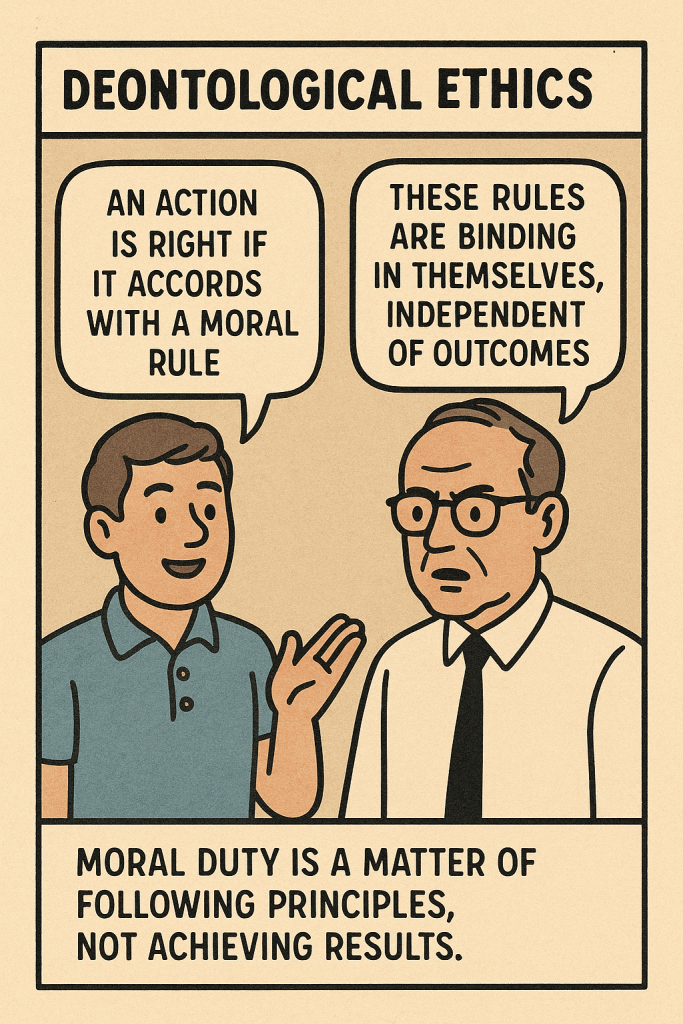
Deontological ethics holds that the rightness or wrongness of actions depends on whether they fulfill our duties or adhere to moral rules, not solely on consequences. The term “deontology” comes from the Greek deon, meaning duty or obligation. In a deontological framework, certain actions are morally required or forbidden in themselves, regardless of the results they produce. Deontologists often stress principles, rules, and the intrinsic moral nature of acts.
Where a consequentialist might say “Lie if it leads to good outcomes,” a deontologist might say “Do not lie, because honesty is a duty,” even if a particular lie could have better results. Deontological theories introduce moral constraints or absolutes: lines that must not be crossed even for good ends.
Key aspects common in deontology:
- Moral rules or laws: There are certain universal rules (e.g., “Do not kill innocents,” “Keep your promises,” “Respect others’ rights”) that define what actions are right or wrong.
- Intrinsic rightness: An action can be right or wrong by its very nature (for instance, murder is wrong because it violates the victim’s right to life, not because of its effect on overall happiness).
- Focus on intentions/principles: Many deontologists evaluate the agent’s intention or the principle they act on (their maxim, in Kantian terms) rather than the outcome. If you do the right thing for the right reason, you are moral—even if things turn out badly.
Deontology includes a range of theories. We’ll cover a few central sub-branches/representative ideas:
- Kantian ethics (duty derived from rationality and universal principles)
- Divine Command Theory (duty as dictated by God’s commands)
- Natural rights theories (duties not to violate fundamental rights of persons)
Kantian Ethics (Immanuel Kant’s Categorical Imperative)
Immanuel Kant (1724–1804) is arguably the most influential deontologist. Kant sought a foundation for morality in reason itself. He argued that moral duties are derived from a single rational principle he called the Categorical Imperative (CI). “Categorical” means it applies regardless of one’s desires (unconditional), and “Imperative” means a command. The CI is essentially a universal moral law that rational beings must follow.
Kant formulated the CI in several ways; two famous formulations are:
- Universal Law Formula: “Act only according to that maxim whereby you can at the same time will that it should become a universal law.” This means: before you do something, imagine if everyone followed the same principle of action. If the action’s guiding rule (maxim) cannot be universalized without contradiction or chaos, then it’s not moral. For example, if your maxim is “I will lie to get myself out of trouble,” universalizing that would mean “everyone may lie to get out of trouble” – but then lies would deceive no one (since no one expects truth) and the concept of trust breaks down, making your maxim ineffective or self-defeating. Thus, lying fails the CI test; it cannot be a universal moral law, so it’s forbidden.
- Humanity Formula: “Act so that you treat humanity, whether in your own person or in that of another, always at the same time as an end and never merely as a means.” In simpler terms, this says: never treat people just as tools for your goals; always respect that each person has their own inherent worth (an end in themselves). For Kant, humans (and any rational agents) have dignity and must not be exploited or manipulated, even for good outcomes. This is a strong statement of respect for individual rights and autonomy. For example, using a person as an unwitting test subject to develop a cure (against their will) would be treating them as a mere means, which Kantian ethics prohibits, no matter how beneficial the cure might be for others.
Kantian ethics emphasizes intentions and principle-following. It’s not enough to do the right thing; you must do it for the right reason – namely, because it’s your duty as dictated by rational moral law, not because of expected consequences or personal inclination. If you help someone out of sympathy or for reward, that has no moral worth for Kant; but if you help them because you recognize a duty to help, then it is truly moral.
Example (Kantian duty): Suppose you have a chance to embezzle money at work without getting caught, and you could give that money to feed hungry children. A utilitarian might lean toward embezzling if it does more good. A Kantian, however, would ask: what is the general rule of action here? Perhaps “It’s okay to steal others’ money when I can use it for a good cause.” Could that be universalized? Likely not – if everyone stole whenever they personally judged the cause good, property rights and trust in financial systems would disintegrate; the maxim wouldn’t work universally and people would be using others’ assets as mere means to their own ends. So Kant’s ethics would say don’t steal, period. You have a duty to be honest and respect property, even if your intention is to do charity – because you must respect the other people (in this case, the owners of the money) as ends in themselves. The moral path is to help others through permissible means, not through deceit or theft, no matter how noble your goal.
Kant’s deontology gives us moral absolutes: lying, stealing, killing the innocent are always wrong because the maxims fail the CI or treat persons as mere means. Kant famously argued you should not lie even to a murderer who asks where his intended victim is, because lying cannot be universalized (this rigid stance is widely debated!). Kantian ethics is thus rule-based and inflexible, which is its strength (clear guidance, no loopholes for “well in this case maybe do bad for good outcome”) but also seen as a weakness (what about cases where duties clash or sticking strictly to a rule seems to cause preventable harm?).
Kantian ethics has a profound legacy in the concept of human rights and dignity. The idea that individuals have inviolable rights and must not be treated as mere tools aligns with Kant’s humanity principle. Many contemporary deontologists build on or modify Kant’s framework to accommodate some flexibility or to handle situations of conflicting duties (like telling a lie to save a life).
Divine Command Theory
Divine Command Theory (DCT) is the view that moral right and wrong are determined by the commands of God (or the gods). In its simplest form, it says: an action is morally right if God commands (or wills) it; wrong if God forbids it. Morality is thus grounded in divine authority.
This theory is deontological in the sense that it provides absolute rules (God’s commands) that must be obeyed, regardless of consequences or human opinion. For a devout believer, these commands constitute duties. For example, if a holy scripture or revelation says “Do not commit adultery” or “Give to the poor,” those are moral obligations because God has decreed them. Conversely, acts like theft or murder are wrong because God has prohibited them (e.g., in the Ten Commandments or other religious laws).
Key aspects of divine command theory:
- Moral authority: God is the ultimate legislator of morality. God’s perfect nature or will defines goodness. As one source puts it, for a theist, “the moral acts are those that we would all agree to if we were unbiased, behind a ‘veil of ignorance’” is Rawls’s contractarian view, but “the moral acts are those commanded by God” would be the DCT perspective.
- Obligation through obedience: To be moral is fundamentally to do God’s will. The virtue is in obedience and faithfulness to divine law.
- Objectivity (for believers): It offers an objective foundation (God’s will) so it’s not relative to human culture or individual – though of course different religions have different divine commands reported, which complicates things.
Example (Divine Command in practice): Consider the moral question of honoring one’s parents. A divine command ethicist might point to a scripture like “Honor thy father and mother” in the Bible, and conclude that honoring parents is morally required because God commanded it. Even if someone’s parents are difficult or one might think in purely human terms they don’t deserve honor, a believer could see the duty as non-negotiable due to divine authority. Or take prohibitions like “Do not eat pork” (in certain religious traditions) – those become moral rules for adherents not because of health or consequences necessarily, but solely because God’s law prescribes them.
One famous dilemma related to divine command theory is Plato’s Euthyphro dilemma: “Is an action good because God commands it, or does God command it because it is good?” This raises a potential problem: If it’s good because God commands it, morality seems arbitrary – God could command anything (even cruelty), and it would be “good” just because He said so. On the other hand, if God commands it because it’s good, then goodness is independent of God (God is just recognizing moral truths, not creating them, which contradicts a strong version of DCT). Different theologians and philosophers respond variously: some say God’s nature is good and He wouldn’t command cruelty (so it’s not arbitrary, because God’s nature itself is the standard of good). Others adjust DCT to avoid arbitrariness but maintain that without God, we’d have no reason to be moral.
Divine command theory strongly influences many religious believers’ approach to ethics. It emphasizes obedience, duty, and faith. However, secular ethicists often criticize DCT as not accessible to non-believers and as potentially endorsing problematic things if one believes God commanded them (for example, in scripture God commands Abraham to sacrifice his son Isaac – was it morally right for Abraham to be willing to do so? A strict DCT might say yes, because obeying God is paramount, even above normal moral duties like not killing your child).
Regardless of one’s view on its truth, divine command theory underscores how morality is often experienced by people as following a higher law. It clearly falls in the deontological camp: the rightness lies in the adherence to command/duty, not in weighing outcomes.
Rights-Based Ethics (Natural Rights and Human Rights)
Another influential deontological perspective revolves around the concept of rights. Rights-based ethics holds that individuals possess certain moral rights (entitlements) by virtue of their nature (often said to be natural rights) or by virtue of moral or legal conventions (human rights in political context). Morality then consists in respecting these rights – and duties arise as the obligation to not violate others’ rights (and sometimes to aid in securing them).
Natural rights theory is historically associated with philosophers like John Locke (17th century). Locke argued that by nature (given by God, in his view), human beings have fundamental rights to life, liberty, and property. These rights are prior to any social or political arrangement; governments are formed mainly to protect these natural rights. For Locke, violating someone’s natural rights (murdering them, enslaving them, stealing their property) is morally wrong, period – not because of consequences but because it infringes what inherently belongs to that person.
Rights are deontological in that they function as side-constraints on actions. As philosopher Robert Nozick put it, “Individuals have rights, and there are things no person or group may do to them (without violating their rights).” For instance, even if killing one person could save five (a net positive consequence), a rights view would say you cannot kill the one because that violates their right to life. Each person is inviolable. This is aligned with Kant’s idea of treating persons as ends – rights kind of codify that: to treat someone as an end, you at minimum respect their rights (to life, to autonomy, etc.).
Some important features:
- Rights often come in pairs with duties: If X has a right to something (say, freedom of speech), others have a duty not to interfere with X’s speech. A right to life implies others have a duty not to kill you (and perhaps a duty to help preserve your life in some cases).
- Rights can be negative (the right to not be subjected to certain harms or interference – e.g., right not to be assaulted, right to privacy) or positive (the right to receive certain benefits or aid – e.g., some argue there’s a positive right to basic healthcare or education, meaning others/society has duty to provide these).
- Natural rights are considered inherent and inalienable (you cannot be rightfully deprived of them). They often are thought to come from human nature or God. For instance, the U.S. Declaration of Independence (1776) speaks of people being “endowed by their Creator with certain unalienable Rights… Life, Liberty and the pursuit of Happiness.”
- Human rights, as used in modern international discourse, are similar but they’re often justified in a more secular way (perhaps grounded in human dignity or needs). They include rights like equality before law, freedom of religion, freedom from torture, etc. These are enumerated in documents like the UN’s Universal Declaration of Human Rights.
Example (Rights in action): Consider a scenario: A government wants to silence a minority religious group because it believes doing so would increase overall social harmony (maybe the majority is uncomfortable with that minority). A utilitarian government might consider doing it if it truly believed it increases net happiness. But a rights-oriented approach would say: “No, people have a right to religious freedom and expression. That right cannot be trampled just because doing so would please the majority. The minority’s liberty is protected.” Similarly, in criminal justice, a rights view emphasizes due process – you can’t just punish an innocent person even if it would scare others into obedience (violating the innocent person’s rights to justice).
Natural law theory, often in the Catholic tradition, is related – it holds that moral principles (including rights) are derived from the nature of humans and the world (as designed by God’s rational order). People have natural inclinations (to life, to procreate, to know truth, to live in society, etc.), and from these a set of natural laws and rights can be deduced. For example, because of the value of life, natural law ethicists say there’s an absolute prohibition on intentionally killing the innocent (just like rights/duty ethics).
Nozick’s libertarian rights theory (1970s) held that individuals have robust rights to life, liberty, and property – so much so that any redistributive taxation beyond minimal necessary for protection is immoral (because it violates property rights). That’s one political extension of deontological rights thinking.
Rights-based ethics vs. Kant: They align heavily – respecting rights is akin to respecting the intrinsic worth of individuals. But rights talk adds a more legalistic or entitlement-focused language. It also allows some pluralism: one can list multiple specific rights that might come into conflict and need balancing.
One challenge in rights ethics is conflict of rights: What if one person’s right seems to infringe on another’s? For instance, one person’s right to freedom of speech vs another’s right not to be slandered – those need delineation. Or a serious one: a fetus’s right to life vs a woman’s right to bodily autonomy (the abortion debate often pits these perceived rights against each other). Deontologists have to find principled ways to adjudicate such conflicts (e.g., which right is more fundamental or if one right is conditional).
In summary, rights-based ethics provides a framework of inviolable protections for individuals, which generate duties for others to refrain from certain actions (or perform certain supportive actions). It’s a cornerstone of many ethical and legal systems worldwide today. It stands opposed to purely outcome-based reasoning: even if violating one person’s rights would benefit others greatly, it’s typically deemed impermissible. This moral stance was clearly illustrated in the earlier-cited Normative Ethics Wikipedia excerpt: rights theories hold that humans have absolute, natural rights which must not be transgressed.
Other deontological theories: Beyond Kant, divine commands, and rights, there are other deontological approaches. For example, W.D. Ross’s prima facie duties: Ross recognized multiple independent duties (fidelity, reparation, beneficence, justice, etc.) that aren’t absolute but generally binding unless they conflict, in which case we must judge which is weightier in context. This is a softer deontology, admitting that sometimes duties must yield to stronger duties. It captures moral common sense that we have many kinds of obligations. Ross’s theory is deontological because it’s about duties rather than max utility, but it’s not rigid absolutism like Kant’s – it requires judgment to balance duties when they clash.
To wrap up deontology: These theories emphasize principle, duty, and the inherent morality of actions and respect for persons, often providing a bulwark for individual rights and ethical rules that should not be broken. They address some shortcomings of consequentialism (like sacrificing individuals for aggregates) but face their own difficulties (like handling tough moral dilemmas where rules conflict or the costs of rule-following seem unbearably high).
Virtue Ethics
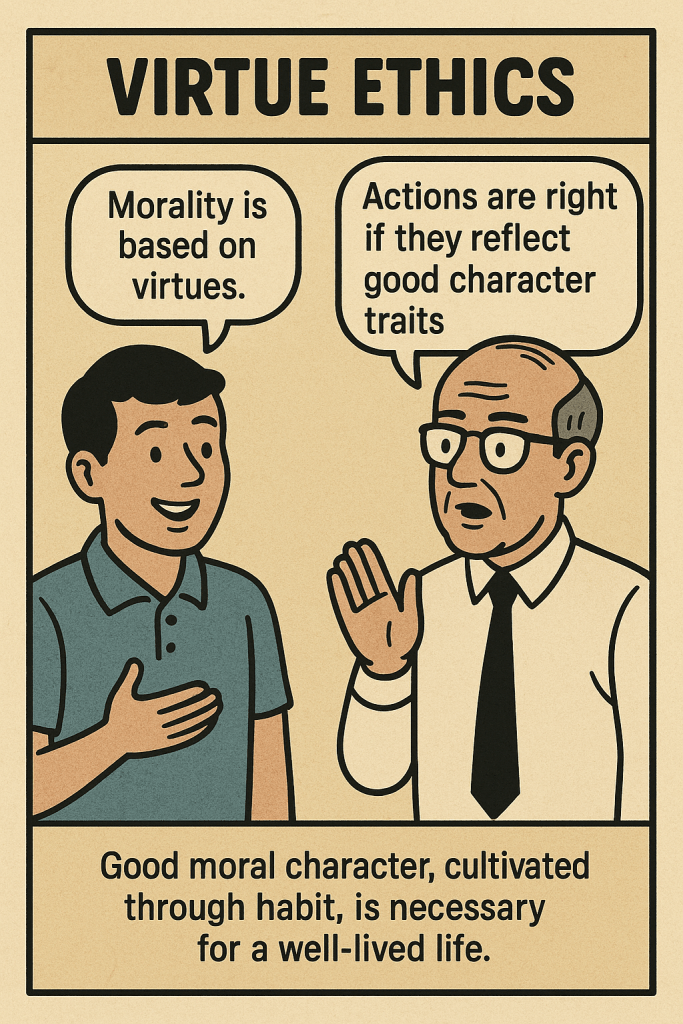
Virtue ethics shifts the focus from rules or consequences to character. It is an approach to normative ethics that emphasizes the virtues or moral character of the person carrying out an action, rather than the ethical status of the act itself (deontology) or its consequences (consequentialism). In other words, virtue ethics asks not “What should I do?” but more fundamentally “What kind of person should I be?”
At the heart of virtue ethics is the concept of a virtue: a trait of character that is morally valuable – such as honesty, courage, compassion, generosity, fidelity, integrity, fairness, self-control, prudence, etc. A virtuous person will tend to do the right things for the right reasons, so by cultivating good character, good actions follow naturally. Likewise, vice (bad traits like cowardice, greed, dishonesty) leads one astray.
The roots of virtue ethics lie in ancient philosophies, especially those of Aristotle in the Western tradition and Confucian thinkers in the Eastern tradition (and also in many others, such as Stoics). We will outline the Aristotelian paradigm as the primary example of virtue ethics, and also mention how other traditions align.
Aristotelian Virtue Ethics
Aristotle (384–322 BCE) in his Nicomachean Ethics presented a systematic virtue ethics. Some key elements of Aristotle’s approach:
- Teleology (purpose): Aristotle believed everything has a purpose or end (telos). For humans, he argued our ultimate end is eudaimonia, often translated as “flourishing” or “happiness” in a deep sense (not just pleasure, but living and faring well as a human). Ethics, for Aristotle, is about how to live a life conducive to eudaimonia.
- Virtue (arete): Virtues are excellent states of character that enable a person to fulfill their purpose and live well. They are developed habits or dispositions to act and feel in certain good ways. For example, courage is a virtue that helps one handle fear and face challenges appropriately, contributing to a good life; temperance is a virtue concerning pleasure and self-control, etc.
- Doctrine of the Mean: Aristotelian virtues are often means between extremes (the famous “golden mean”). Each virtue is a moderate position between two vices of excess and deficiency. For example, courage is the mean between recklessness (excess of fearlessness) and cowardice (excess of fear). Generosity is between prodigality (giving too much or unwisely) and stinginess (giving too little).
- Practical wisdom (phronesis): To apply virtues in real life, one needs practical wisdom – the intellectual virtue that allows one to discern the right mean in the right situation. It’s not a simple formula; it requires experience and good judgment. A virtuous person with phronesis can see what’s the honorable or fitting action in context.
- Holistic character: Virtues are deeply interconnected; truly having one virtue often implies having others, because they form a coherent character aimed at the good life. Aristotle thought you need all the main virtues to fully flourish.
In virtue ethics, moral education and development are crucial – one cultivates virtues through practice, habituation, mentorship, and community values. Early in life, you might follow examples and rules, but the goal is to internalize virtues so that doing the right thing becomes second nature, done with the right mindset and feelings.
Example (Virtue Ethics in a scenario): Imagine a friend confides a difficult secret to you, and later someone else pressures you to tell that secret. What would virtue ethics consider? It’s not primarily weighing duty or outcome, but thinking: “What would an honest and loyal friend do? I want to be a trustworthy, benevolent person.” The virtuous response likely is to keep the confidence, because loyalty and honesty are virtues in friendship. However, if the secret is, say, something harmful (imagine the friend plans to commit a crime), then other virtues like justice or compassion for potential victims come into play – practical wisdom is needed to determine which virtue takes precedence. A virtuous person might persuade the friend to reconsider, or break the secret in extreme cases for a greater good, but only after serious reflection on integrity, harm, and loyalty. The point is the emphasis on moral character guiding the choice, rather than a strict rule or just utility.
Virtue ethics often provides a more contextual, flexible approach: it doesn’t give one-size-fits-all rules, but rather encourages developing good judgment and sensitivities. As a result, it’s good at handling the nuances of personal relationships and what to do when values conflict, because it’s less algorithmic and more about balancing virtues.
One criticism historically was that virtue ethics doesn’t give clear action-guidance (“What do I do in dilemma X?”). Virtue ethicists respond that it does implicitly: “Do what a virtuous person would do.” But skeptics say that’s circular or hard to apply if you’re not already virtuous. Still, proponents argue that people naturally emulate moral exemplars (like a courageous hero or a compassionate mentor) which is action-guiding.
Another aspect: virtue ethics looks at a whole life rather than isolated acts. It asks what sort of life is worth living and what sort of person to be. So it integrates ethics with personal fulfillment – doing good and living well are not separate (whereas one might feel deontology or utilitarianism could ask sacrifices that conflict with one’s own flourishing, virtue theory tries to harmonize moral good with personal good – in theory, being virtuous leads to true happiness).
Virtue ethics has seen a big revival since mid-20th century, partly as a response to perceived coldness of rule-based systems. Modern virtue ethicists (like Philippa Foot, Alasdair MacIntyre, Martha Nussbaum, Rosalind Hursthouse) have expanded it, including considering virtues in the context of the community (MacIntyre) or applying it to contemporary issues like animal ethics, environmental ethics, etc., by talking about virtues in those domains (like virtues of stewardship toward nature).
Other Virtue Traditions (Non-Western and Contemporary)
While Aristotelian virtue ethics is a cornerstone of the Western canon, many other cultures and philosophies have virtue-centered ethics. For example:
- Confucianism (Role Ethics): The Confucian tradition (Confucius, Mencius, etc.) in ancient China is heavily virtue-based. It emphasizes virtues like ren (benevolence/humaneness), li (proper conduct, observing ritual propriety and social roles), yi (righteousness), zhi (wisdom), xin (trustworthiness), xiao (filial piety), etc. Confucian ethics is very relational – virtues are cultivated within the context of family and society roles (child to parent, ruler to subject, friend to friend, etc.). The idea is that by fulfilling one’s role with virtue, harmony is achieved in society. Confucian role ethics could be seen as a sub-branch of virtue ethics: one becomes a good person by excelling in the duties of one’s relationships (being a good parent, a loyal minister, etc.) with virtues guiding those roles. Unlike Kantian universal rules, Confucius gave guidelines that are sensitive to context and relationship (e.g., loyalty and filial piety might mean telling your father his wrongdoing gently or even covering for him to outsiders, which a strict duty ethic might not condone, but Confucian virtue of family loyalty might). There is a strong emphasis on moral education and ritual practice to cultivate virtue.
- Buddhist Ethics: While often framed in terms of precepts (non-violence, no lying, etc.), Buddhism also encourages development of virtuous qualities like compassion (karuna), loving-kindness (metta), equanimity, and wisdom (prajna). The ideal is the enlightened being (like a bodhisattva) who perfectly embodies compassion and wisdom. So it’s partly a virtue ethic focusing on character transformation to eliminate vices such as greed, hatred, and delusion and replace them with their opposite virtues.
- Stoicism: In Hellenistic philosophy, Stoics like Epictetus and Marcus Aurelius emphasized virtues (wisdom, courage, justice, temperance) and the importance of inner character. They taught that virtue is the only true good and is sufficient for happiness, regardless of external circumstances – a very stringent virtue ethic.
- African ethics: Many African traditional ethical systems (as understood through proverbs and practices) stress community harmony and virtues like generosity, hospitality, courage, and respect. The concept of Ubuntu (“I am because we are”) encapsulates an idea of communal virtue: a person becomes a person through other persons, highlighting relational virtues like compassion and solidarity.
- Contemporary “ethics of care”: (Although often considered its own framework, it’s closely related to virtue ethics.) This feminist-inspired perspective emphasizes traits like empathy, caring, nurturance, and maintaining relationships. It suggests that traditional ethics overly prioritized masculine-coded virtues like justice or autonomy and neglected the importance of care and connection, which are vital virtues often cultivated in contexts of family and caregiving. Carol Gilligan and Nel Noddings, for example, argue for the moral importance of an ethic of care. We could classify care ethics as a kind of virtue ethic (focusing on a particular cluster of virtues around caring relations), or one could consider it separate. In our tree (as updated in normative “Other theories”) I actually list Ethics of Care separately, so I won’t delve too deeply here – but note the overlap.
Virtue ethics, being more about cultivating excellence than obeying laws, often ties ethics to a vision of the good life and human nature. Different cultures have different ideals of what an excellent human life looks like, hence variations in which qualities are emphasized (for example, warrior cultures might prize bravery and honor above all; monastic traditions prize purity and humility; communal societies prize generosity and loyalty, etc.). Virtue ethics can adapt to these differences, sometimes raising the question of relativism of virtues: are virtues universal or culturally specific? Many virtue ethicists argue there’s a core of human virtues (because of common human nature, needs, and social life), but also acknowledge culturally specific expressions.
Virtue vs. duty vs. consequence: Ideally, all three frameworks can coincide: A virtuous person will often follow moral rules and achieve good outcomes naturally. But they emphasize different layers: virtue ethics says “Become honest and you’ll habitually tell the truth (duty) and that will foster trust (good outcome).” Deontology says “Always tell the truth (duty), because it respects persons.” Utilitarianism says “Tell the truth when it leads to better outcomes (trust), otherwise lying could be okay if it saves a life.” You see the differences: virtue ethics invests in character first, trusting that good acts follow; deontology mandates the act from a principle; utilitarianism looks at each act’s outcome.
In moral philosophy today, many see these frameworks as complementary rather than strictly opposed. Some ethicists craft integrated approaches (e.g., a utilitarian might still value virtues as useful dispositions; a deontologist might acknowledge virtues help us adhere to duties; a virtue ethicist might accept that virtues generally promote good consequences).
To conclude virtue ethics: It provides a rich, human-centered account of morality, urging us to emulate moral exemplars, cultivate the right emotions and habits, and strive for personal excellence. It resonates with our intuitions that who we are (character) matters morally, perhaps even more fundamentally than isolated actions.
| Normative Theory | Focus of Morality | Guiding Question | Primary Criterion for Right Action |
|---|---|---|---|
| Consequentialism | Outcomes or consequences | “What result will this action lead to?” | The right action is the one that produces the best overall consequences (e.g., maximum happiness or welfare). “Ends justify means.” |
| Deontology | Duties, rules, and intrinsic rightness | “Am I following a moral rule or duty?” | The right action is the one that adheres to moral duties or rights (e.g., do not lie, do not harm innocents), regardless of outcomes. “Follow the moral law.” |
| Virtue Ethics | Character and virtue | “What would a virtuous person do?” | The right action is what a person of good character (with virtues like honesty, courage, compassion) would do in the situation. Emphasis on being over doing. |
| Social Contract (Contractarianism) | Fair agreement or principles of justice | “What rules would free, equal people agree to?” | The right action follows principles that rational individuals would consent to under fair conditions (e.g., behind a veil of ignorance). “What if everyone had to agree to this?” |
| Ethics of Care | Relationships and care responsibilities | “How will this affect the relationships and needs involved?” | The right action is one that is caring and maintains/respects relational responsibilities (attentive to context, needs of particular others). “Care for those dependent on you.” |
Social Contract Theory (Contractarianism and Contractualism)

Social contract theory is the view that moral and political rules derive their authority from a kind of agreement among individuals. In normative ethics, contractarian or contractualist approaches suggest that the principles of right and wrong (or justice) are those that everyone would agree to under certain fair conditions. Essentially, morality is understood as the outcome of a social contract – a mutually beneficial arrangement that rational agents would choose.
This perspective has roots in political philosophy (Hobbes, Locke, Rousseau) explaining the legitimacy of governments by an original contract. In ethics, modern philosophers like John Rawls and T.M. Scanlon have developed sophisticated versions:
- Contractarianism typically refers to Hobbesian-style accounts where rational (perhaps self-interested) individuals agree to terms of cooperation to avoid conflict and secure mutual benefit.
- Contractualism often refers to accounts like Scanlon’s, where morality consists of principles that no one could reasonably reject – emphasizing justifiability to each person.
Key features:
- It’s normative because it tells us: an act is right if it conforms to principles that rational people would agree to in some idealized contracting situation.
- It often assumes a condition of equality and impartiality in the contract scenario, to eliminate bias. For Rawls, this is the famous “veil of ignorance” – a hypothetical scenario where individuals choose principles for society without knowing their own place in it (their race, class, talents, etc.), so they choose fairly. Rawls held that behind the veil, people would agree to two main principles of justice: equal basic liberties for all, and social/economic inequalities arranged to benefit the least well-off (his “difference principle”).
- Contract theory highlights reciprocity and mutual respect: rules should be acceptable to all who must live by them. It’s a form of procedural realism – what’s “right” is defined by a fair process of agreement.
Example (Contract reasoning): Consider how one might justify a moral rule like “Don’t steal.” A contractarian reasoning might be: if we were all setting up social rules, none of us would want a rule allowing stealing – because anyone could be the victim. We’d all agree property rights should be protected to have security and trust. Thus “no stealing” is morally binding as part of the social contract we’d consent to. In Hobbes’s state of nature, life is “solitary, poor, nasty, brutish, and short” because without rules, everyone has reason to preemptively attack or cheat. To escape that, people collectively cede some freedoms (like the freedom to steal or harm) and agree to constraints in exchange for others doing likewise – that’s the contract making morality and law possible.
For a more interpersonal view: Scanlon’s contractualism (in What We Owe to Each Other, 1998) says: an act is wrong if it is disallowed by principles that nobody could reasonably reject as a basis for informed, unforced general agreement. So if I’m considering doing something, I should ask: could I justify this action by some principle to which no one could reasonably object? If not (meaning at least one person could reasonably reject it because it would impose something unacceptable on them), then the action is wrong. For example, could there be a principle that allows breaking promises whenever it’s convenient? People as promisees would reasonably reject that – they couldn’t trust promises. So a principle permitting convenient promise-breaking is not one that could be agreed to by all; hence breaking promises for convenience is wrong.
Contractualism emphasizes justifiability to others as the ground of morality. It’s a strongly egalitarian view because everyone’s standpoint matters in the agreement. It also aligns with Kantian respect: treating people not only as means but as participants whose consent matters.
Relation to deontology and consequentialism: Social contract is often categorized separately but shares elements with both:
- It is deontological in that it generates rules/duties (the agreed principles) that often have a universal character (e.g., Rawls’s principles or Scanlon’s test yield duties like respect rights, help others to some extent, etc.). The reason is not pure duty for duty’s sake but duty because of hypothetical agreement – but once agreed, those principles hold regardless of outcome in particular cases (e.g., if we agreed everyone has basic rights, we won’t violate someone’s right even if doing so yields better outcome).
- It has a consequentialist flavor insofar as the contract is motivated by mutual benefit or reasonableness (like improved social outcomes or protection of interests). But it’s not maximizing utility per se, it’s more about fairness.
An advantage of contract theories: they frame morality as a rational solution to problems of social living, which resonates with an intuition that morality is about getting along with others on terms of mutual respect. Also, it naturally incorporates the Golden Rule logic: don’t propose rules you wouldn’t accept if you were at the short end.
The Veil of Ignorance (Rawls): Rawls’s thought experiment is quite important: In an original position behind a veil of ignorance, you don’t know if you’ll be rich or poor, strong or weak, majority or minority. Under such uncertainty, Rawls argued, people would choose very egalitarian and liberty-guaranteeing principles – ensuring rights for all and helping the worst-off – because you might end up being that worst-off person. It’s basically a risk-averse fair deal. This yields a kind of deontological framework of justice (not utilitarian, since behind the veil one wouldn’t risk being a huge loser for someone else’s huge gain – so you wouldn’t choose mere average utility max, you’d ensure a fair minimum).
Example (Rawls’s principles applied): Suppose we’re designing a healthcare system by contract. Behind the veil, we don’t know if we’ll be healthy or sick, rich or poor. We likely agree on a principle that everyone gets access to basic healthcare (a fairly egalitarian principle) because no one wants to risk being sick and unable to afford care. That principle might then direct our concrete policies in reality. Not everyone follows Rawls’s exact scheme, but that’s the style of reasoning: find just principles by asking what free equals would agree to if none had bargaining advantages.
Real vs. hypothetical contract: Critics sometimes ask, “If morality rests on a contract, when did we sign it? I never literally agreed to all current moral rules.” Social contract theorists usually mean a hypothetical contract – it’s not that we all did sit and sign something, but that if we were all in appropriate conditions, we would agree to these terms. Hypothetical may sound weaker (why should a hypothetical agreement bind me?), but proponents argue that it’s the best way to determine fairness or objectivity. If you wouldn’t agree to something in a fair setting, then it’s not truly just or moral.
Hobbes’s theory was more “actual” in the sense he described that people in history implicitly or explicitly formed society and gave authority to sovereigns. Locke thought we tacitly consent to government by enjoying its protections. Those are partly empirical claims – and people can withdraw consent (rebellion) if government breaches terms (Locke). But those are more political contract uses. In pure ethical theory, most use the hypothetical approach (besides, actual agreements could be coercive or uninformed, so not a reliable guide to fairness).
Contract ethics and game theory: There’s an interesting connection to rational choice and game theory: the social contract can be seen as solving collective action problems (like prisoners’ dilemmas) by establishing trust and cooperation that is rational for each because others also cooperate. Hobbes’s contract is basically solving a giant multi-person prisoners’ dilemma of war vs peace. Modern contractarians like David Gauthier attempted to ground morality in mutual advantage and rational bargaining solution concepts.
Limitation: One common criticism is: does contract theory overly depend on rational agreement among equals? What about parties who can’t participate equally, like non-human animals or future generations or severely disabled individuals who can’t bargain – do they get moral consideration? Rawls said the principles chosen would likely protect animals indirectly via a principle of treating nature well, but animals aren’t “contractors.” Scanlon says we only owe duties to beings we can justify things to – which doesn’t directly include animals since they aren’t part of justification community. Some see that as a limitation. Others expand the hypothetical contract to include, e.g., what if we didn’t know if we’d be a human or an animal (some have done weird expansions like that) or simply say our duty to animals is derived from something else (virtue or utilitarian compassion, etc.). Similarly, contract theory in classical form doesn’t automatically give environmental ethics except insofar as it matters for humans – though one could argue rational beings would agree to conserve environment for their descendants, etc. It’s a point of debate.
In summary, social contract theory in ethics provides a model of morality as a fair agreement – often blending concerns for fair process (like deontology’s equal respect) and mutual benefit (like consequentialism’s focus on outcomes). It underlies much of modern liberal political thought and informs moral frameworks that prioritize consent, fairness, and reciprocity. It answers the question: “Why be moral?” with: “Because it’s in each of our rational interests to accept constraints that make everyone’s lives better – you’d agree to it if the decision were made under fair conditions.”
Ethics of Care (Feminist Care Ethics)
The ethics of care (or care ethics) is a relatively modern development (late 20th century), arising largely from feminist philosophy, that emphasizes interpersonal relationships, empathy, and the moral importance of caring for others. It critiques traditional ethics for being too focused on abstract principles (justice, autonomy, utility) and neglecting the concrete experiences of care and dependency that are central to human life.
Key ideas in care ethics:
- Relationships and Context: Care ethicists argue that morality is deeply rooted in the specific contexts of our relationships (family, friends, community). Instead of viewing individuals as isolated rational agents (as in many other theories), care ethics sees people as inherently relational, often in unequal positions (e.g., parent-child, nurse-patient). Ethical decisions should account for the nuances of these relationships and responsibilities that come with them.
- Emotion and Empathy: Emotions like empathy, compassion, sensitivity, and love are not irrational biases to overcome (as some traditional views might hold) but are valuable guides to understanding what others need. Caring is both a practice and a value; feeling concern for someone’s suffering and wanting to help is a moral motivation to be cultivated, not ignored.
- Partiality and Particularity: Unlike the dominant Western ethical theories that stress impartiality (treat everyone equally, apply universal rules), care ethics suggests that it’s often ethical to give priority to those you have close relationships with, because you have special duties to them. It’s not that care ethicists reject fairness or general rules, but they argue morality isn’t only about universal principles – it’s also about meeting particular others’ needs in their particular situation. For example, a mother prioritizing her child’s needs isn’t being “unfair” by not treating all children equally; it’s seen as morally appropriate caring.
- Dependency and Vulnerability: Care ethics highlights that at various points, everyone is dependent on others (infancy, illness, old age) and someone must care. Thus it shifts the perspective from independent actors to networks of dependency. It values traditionally feminized roles of caregiving (mothering, nursing, etc.), which historically were undervalued in moral theory.
- Holistic and Narrative Thinking: Some portray care ethics as using a narrative approach to problems – understanding the story and context of those involved – rather than applying a formula. It’s a more situational ethic, wary of one-size-fits-all solutions.
The concept of care can be defined as both an activity (caring for someone, which involves labor, time, skill) and an orientation (caring about someone, an attitude of concern). A moral person in this view is attentive, responsive, and respectful of others’ needs and vulnerabilities, especially those with whom one has a relationship.
Example (Ethic of Care at work): Consider a situation where you have to decide between working overtime to help more customers at your job or going home to take care of your ill parent. A classical impartial principle might say “Well, each person’s need counts equally, maybe more customers helped is more total good.” But a care ethics perspective would legitimize prioritizing your parent because you have a special relationship and responsibility there. Attending to that relationship and the parent’s immediate needs is morally compelling, even if an impartial calculus might favor the greater number of customers. Care ethics says morality sometimes properly involves partiality – you should care more for those who depend on you or who are close to you, and that’s not immoral favoritism but rightful context-sensitive duty.
Another example: In healthcare, a purely principle-based ethicist might focus on autonomy and justice (ensuring patient consent and fair allocation of resources). A care ethicist, while not denying those, might highlight the importance of the caregiver-patient relationship, the emotional support, and understanding the patient’s narrative. For instance, delivering bad news – a care perspective emphasizes empathy in how it’s done, not just the duty to inform truthfully. The manner of caring communication itself has ethical value.
Origins: Carol Gilligan’s book In a Different Voice (1982) is often credited with inspiring care ethics. She argued that Kohlberg’s famous stages of moral development (which prioritized abstract justice reasoning) undervalued the different moral reasoning some women displayed, which was more about care and responsibility in relationships. She refused to say one was better outright, but her work sparked the idea that care perspective is an alternative moral voice.
Philosophers like Nel Noddings, Virginia Held, Joan Tronto, Sara Ruddick and others fleshed out care ethics. Noddings suggested that the basis of morality is the “caring relation” – she even doubted the need for universal principles at all beyond an injunction to care. She described a “one-caring” (person giving care) and “cared-for” dynamic and said ethical behavior occurs when natural caring (like a mother’s for a child) is present or when we recall that ideal and consciously commit to caring in less spontaneous situations.
Care vs. Virtue Ethics: There’s overlap since caring can be seen as a virtue. But care ethics specifically pushes against the dominance of traits like justice and autonomy (often coded male, public sphere) and lifts up care (coded female, private sphere) as equally important. One might fold care into virtue ethics, but care ethicists tend to reconstruct the whole approach to emphasize relational rather than individual excellence.
Care vs. Deontology & Utilitarianism:
- Against deontology: care ethicists argue life’s moral dilemmas are not always best resolved by applying a rule like “tell the truth no matter what” or “respect autonomy above all.” Sometimes, mercy or compassion might mean bending a rule – and care ethics would support that, pointing out rules themselves often come from a context of caring (e.g., truth-telling is important because deception hurts trust and people; but if telling a harsh truth without compassion hurts unnecessarily, care ethic might refine how and when to tell).
- Against utilitarianism: care ethics doesn’t try to maximize an aggregate good dispassionately. It focuses on meeting particular needs, not summing utilities. It would critique a policy that, say, neglects a minority’s severe needs just because majority gets more modest benefit – justice cares about minority rights, and care ethics cares about not abandoning those in great need simply due to numbers.
Applications: Care ethics has been particularly influential in fields like nursing, social work, education – roles traditionally associated with caring. It validates the moral wisdom that practitioners in those fields often voice (that being empathetic and responsive is as crucial as being impartial or following rules).
It’s also been applied to global issues by broadening “care” to thinking about how nations or societies can care for marginalized or distant others (e.g., global poverty as a failure of care).
Challenges: Some criticisms of care ethics:
- Does it reinforce gender stereotypes? (Some worry by valorizing care, which women have been expected to do for free in families, it could entrench the idea “women should care.” Care ethicists respond they want everyone to value care, and they want caring labor recognized and shared, not just dumped on women.)
- Is it too parochial? Does partial caring lead to nepotism or unfairness to those outside one’s circle? Care ethicists agree there’s a balance to strike – caring doesn’t mean neglect justice. They usually see care and justice as compatible and both necessary. A society of pure impartial justice might be cold; a society of pure particular care might be clannish. So they complement.
- Can it form an ethic of large-scale issues (like climate change, where victims are unknown future people or ecosystems)? Some suggest an ethic of care can extend to caring about the planet or future generations by cultivating a sense of global care.
- Does it provide clear action guidance? It might say “be empathetic and consider relationships,” but in a tough conflict (e.g., two people you care about need help at same time), it might not yield a formula. Care ethicists might say moral life is complex and can’t be codified fully – sensitivity and judgment are needed.
Overall, the ethics of care enriches moral discourse by reminding that we are not independent atoms – we start life being cared for, and much of what is good in life comes from caring relationships. It posits care – the active engagement in tending to others’ needs – as a central value. In the expanded moral philosophy tree, it stands alongside or as a corrective to the more traditional theories.
Pragmatic Ethics

Pragmatic ethics is an approach influenced by the philosophical tradition of pragmatism (Peirce, James, Dewey) which views moral principles and truth as not fixed eternal verities but as evolving through practice, experience, and open inquiry. Pragmatic ethics suggests that our moral criteria and principles are not final; rather, they are provisional guides that should be continually tested and improved upon in light of new circumstances and findings, much like scientific hypotheses.
Characteristics of pragmatic ethics:
- Evolution of Morality: It holds that moral ideas change over time as societies progress and as we collectively reflect on what works for human flourishing. There is no absolutely fixed moral code handed from heaven or pure reason; instead, moral knowledge grows as we face novel challenges and learn from consequences.
- Fallibilism: We must recognize our moral judgments are fallible and subject to revision. We shouldn’t treat any principle as beyond questioning – instead, we adapt when faced with situations the old rules don’t handle well.
- Empirical Inquiry: Pragmatic ethicists often emphasize looking at actual outcomes and human needs in context. They are willing to borrow tools from social sciences or natural sciences to inform ethical decision-making (for example, using psychology to understand what actually increases well-being, or experimenting with policies to see effects).
- Pluralism and deliberation: Instead of one supreme principle (like utility or categorical imperative), pragmatic ethics tends to be pluralistic about values (acknowledging a variety of ends like happiness, autonomy, creativity, etc.). It encourages democratic deliberation – let people discuss, experiment socially, and over time we hone in on better solutions.
- Contextualism: In line with other contextual approaches, it doesn’t detach moral reasoning from situational details. Pragmatists like Dewey criticized the rigid “law ethics” and favored a more practical problem-solving mindset.
One might say pragmatic ethics is utilitarian-like in emphasis on outcomes, but it doesn’t necessarily commit to a single measure like pleasure. It’s more experimental: try policies or personal strategies that seem promising, observe consequences, adjust. It’s somewhat virtue-like too in valuing intelligence (practical wisdom) and adaptability as virtues.
A classical pragmatic stance was given by John Dewey, who saw ethics as evolving with human needs and as part of human growth. He believed in moral progress – e.g., how we eventually realized slavery is wrong, or how we expand concern to new groups – as akin to scientific progress: we learn from moral “experiments.”
Example (Pragmatic problem-solving): Imagine a complex issue like drug addiction in a community. A pragmatic ethicist wouldn’t just apply a pre-set principle (“drug use is immoral, punish users” or “autonomy above all, let them be”). Instead, they’d approach it like a social experiment: consult stakeholders, look at evidence, perhaps try out a harm reduction program (like safe injection sites, counseling), then see if it reduces harm and improves lives. If it does, that becomes the new working policy. If not, iterate. The moral “rightness” of a policy is judged by how well it addresses the problem and the human needs involved, rather than by fidelity to an ideological rule. The process is ongoing; as conditions change (say a new drug emerges), the strategies and norms adapt.
Meliorism (belief in improvement) is central: pragmatic ethics is optimistic that by applying intelligence, we can make moral life better (not perfect maybe, but better).
Relation to other theories: Pragmatic ethics can be seen as a method more than a set of specific tenets. It might incorporate bits of utilitarian thinking (focus on outcomes), bits of Kant (concern for principles though seeing them as evolving), and a bit of care (contextual awareness). It’s perhaps not as common as a stand-alone teaching in intro ethics courses, but the idea is present in fields like bioethics or policy making where people often use trial and error and interdisciplinary input (which is quite pragmatic).
The Wikipedia excerpt sums it up: morals evolve socially over lifetimes, and criteria improve as a result of inquiry – referencing founders like Charles Peirce, William James, John Dewey as proponents. They treat moral norms almost like hypotheses to be tested and refined.
One could also align pragmatic ethics with Richard Rorty’s later ideas or with phronesis (practical wisdom) in virtue theory but emphasizing a community dimension of testing things out.
Criticisms: Some might say if nothing is fixed, how do we avoid moral relativism or justify current norms? Pragmatists answer that they don’t deny we can act on current best norms – just that we remain open to revision. They sometimes highlight historical progress as justification (we’re better off morally now that we abolished cruel practices after recognizing through experience and debate that they were harmful).
Another critique: moral truths as evolving might unsettle those seeking certainty. Pragmatists tend to be comfortable with uncertainty if it’s the truth of our condition; better to admit uncertainty and keep learning than to pretend we have final answers and possibly do harm out of dogmatism.
Modern pragmatic approaches: Some applied ethicists are pragmatic in style – e.g., taking public policy stances that are provisional, focusing on solving concrete problems without heavy ideological baggage. Also, casuistry (case-based reasoning revived in medical ethics) is similar in spirit: look at paradigmatic cases, analogize, incrementally build a sense of right action rather than deduce from theory – it’s more bottom-up and revisable, which is pragmatic.
In sum, pragmatic ethics reminds us that ethics is a human endeavor that can improve with experience and critical thinking, and that we should be ready to adapt our moral compass as we gather more knowledge about human well-being and social functioning. It’s less a competitor to other normative theories than a philosophical stance on how to use them flexibly and experimentally.
Role Ethics (Confucian and Communitarian Perspectives)

Role ethics is an ethical framework that highlights the importance of social roles and relationships in defining our moral duties and virtues. The term is often associated with Confucian ethics, where a person is fundamentally viewed as a nexus of roles (child, parent, ruler, subject, friend, sibling, etc.), each with specific expectations and moral significance. In role ethics, “Who I ought to be and what I ought to do depend on what role I am in and the relationships I am part of.”
Key aspects:
- Relational identity: Unlike Western liberal thought that often imagines individuals as autonomous units, role ethics (especially Confucian) sees individuals as constituted by their relationships. One doesn’t exist apart from family, community, society – you are a father or mother, a teacher or student, an elder or younger sibling, etc. Each of these identities carries certain virtues and duties.
- Filial piety and family as model: In Confucianism, the family is the primary training ground of virtue. Filial piety (respect and duty towards one’s parents) is a cardinal virtue, and it is extended analogously to other hierarchical relations (respect for elders, loyalty to ruler). The family roles of parent-child and elder-younger sibling are paradigmatic – how one behaves there should extend to how one behaves with others (e.g., a ruler should care for subjects like a father for children, and subjects should respect rulers like children to a father – albeit this analogy has been critiqued in modern times).
- Harmony and hierarchy: Confucian role ethics doesn’t see hierarchy as necessarily oppressive – if everyone behaves according to role virtues (benevolence from above, obedience or respect from below, etc.), social harmony results. There’s a strong emphasis on rituals (li) which guide role fulfillment with propriety.
- Virtues tied to roles: For example, what is virtuous for a ruler? Benevolence (ren) and justice (yi) in caring for subjects. For a child? Filial obedience and care for parents. For a friend? Faithfulness and trust. The virtues are somewhat role-dependent, though some, like ren (humaneness), are overarching but expressed through roles.
- Moral cultivation through role fulfillment: One becomes an ethical person by playing one’s roles well. Confucius often gave advice like, “Let the ruler be a ruler, the minister a minister, the father a father, and the son a son” meaning each should properly enact the duties of their station.
Contemporary ethicists have also explored communitarian or contextual ethics which overlap with role ethics by arguing that community and social identity shape our moral obligations more than abstract individualism suggests. Thinkers like Michael Sandel or Alasdair MacIntyre critique the view of the “unencumbered self” and emphasize that we all start with certain ties and narratives (e.g., born into a family, a culture, a history) which give us specific responsibilities and moral starting points. MacIntyre famously said we can’t avoid starting from our roles and traditions; to ask “What ought I do?” you must consider “What roles do I inherit and what is the story of my community?”
Example (Role-based duty): Suppose your parent is aging and needs help. Role ethics straightforwardly says: as a son or daughter, you have a special duty to care for your parent (the virtue of filial piety). A Kantian might frame a similar duty as one to treat persons with dignity including gratitude to parents, a utilitarian might say caring is good if it maximizes welfare, but role ethics just directly says the parent-child relationship itself is a source of moral value and obligation. Conversely, a government leader facing a decision should, according to role ethics, behave like a “parent” of the state, ensuring the people’s welfare, not exploiting them – this paternalistic metaphor sometimes runs against Western emphasis on individual rights, but it’s key in Confucian tradition (the idea of benevolent leadership, and rebellion is justified if the “parent” ruler becomes tyrannical, forfeiting their role).
Another example: Think of being a teacher. Role ethics suggests a teacher has certain virtues (patience, dedication, fairness to students) and duties (to impart knowledge, to mentor) inherent in the teacher-student relationship. A teacher might feel morally required to go extra lengths to help a struggling student – not because of a contract or a general principle alone, but because the role of teacher includes a sort of caretaking. Similarly, a doctor has role-specific ethics (as seen in professional ethics codes) that emphasize care and confidentiality for patients – which align well with care ethics but also can be seen as role virtues (a good doctor is compassionate, competent, respectful of patient trust, etc.).
Comparison to care ethics: There’s overlap: both emphasize relationships and context. But role ethics is more explicitly about fulfilling socially defined roles, whereas care ethics is more generally about an approach or disposition (caring) which you can have in any context. Role ethics may justify some partiality or special obligations in a more structured way (because of roles). Care ethics justifies partiality because of relationships and dependencies too – so indeed, they are compatible. One could say role ethics is one way societies historically embedded care and duty into stable expectations (like filial duty codifies the care of children for parents, etc.).
Critiques of role ethics:
- It can reinforce traditional social hierarchies and norms that might be unjust. For example, if roles are defined by a patriarchal or feudal structure, role ethics might instruct someone to obey oppressive authority just because that’s their role. Confucians have lots of talk about the ruler’s duty to be just and the minister’s duty to remonstrate if the ruler is wrong – so there are internal checks, but historically it often did support conservative social order. Modern Confucians try to adapt it to egalitarian values.
- People occupy multiple roles which can conflict. E.g., you are a police officer (duty to uphold law impartially) but also a parent (duty to protect your child). If your child commits a crime, these roles conflict. How to choose? Traditional role ethics doesn’t have a clear method for resolving such conflicts except to weigh importance or revert to some other values.
- Autonomy question: Western ethics prizes choosing one’s own path, whereas role ethics is about fulfilling given roles. Critics worry it stifles individuality or moral innovation. Defenders say roles can be interpreted and lived authentically; plus, roles evolve (e.g., what it means to be a spouse today is different in many ways from 200 years ago, ideally more egalitarian).
Despite potential pitfalls, role-oriented thinking remains intuitive in daily life: we often say “as a friend, you should do X,” or “that’s not fitting for someone in her position.” Societies allocate responsibilities via roles (jobs, family positions), and our moral judgments often consider those implicitly (“He’s a doctor – he ought to know better than to spread misinformation,” expecting a role virtue of truthfulness in medicine).
In broad perspective, role ethics and communitarian ethics provide a counterbalance to overly individualistic theories. They remind us that we find ourselves always already in a web of relationships which partly define who we are and what we ought to do. The moral life is, to a large extent, about playing our part in that web in a way that upholds the values of our roles (be it family, community, or profession).
This is a quick recap of the different theories attempting to answer the question “How should one live or act morally?”:
- Consequentialists say: maximize the good (variously defined).
- Deontologists say: adhere to moral duties or rights (like honesty, non-harm, etc.).
- Virtue ethicists say: cultivate a good character and you will do well.
- Social contractarians say: follow principles of justice that everyone would agree to.
- Care ethicists say: be responsive to others’ needs in context through caring relations.
- Pragmatists say: treat moral principles as evolving working hypotheses to be tested and improved.
- Role ethicists say: fulfill the obligations and virtues of your social roles to maintain harmony and order.
Each branch contributes insights, and in practice many people draw on elements of several (one might have virtues, respect certain rules, care for loved ones specially, etc.). Understanding all these provides a rich toolkit for thinking through moral problems from multiple angles.
Applied Ethics
Applied ethics is the branch of moral philosophy that takes ethical theories and principles and applies them to specific, practical issues. It addresses the question: “What is the right thing to do in particular fields of human life or concerning particular moral problems?”

Where normative ethics gives general frameworks (utilitarian, deontological, etc.), applied ethics zooms in on concrete areas such as medicine, business, law, technology, the environment, and so forth. It deals with morally controversial topics and real-world dilemmas, aiming to provide guidance on issues like euthanasia, corporate governance, climate change, professional conduct, and many others.
Applied ethics can be thought of as having many sub-branches or specialized domains – essentially aligning with different spheres of life or social practice. Each domain of applied ethics often combines insights from normative theories with domain-specific facts and contexts. For example, medical ethics takes into account not just abstract principle but also the realities of illness, patient vulnerability, healthcare systems, etc.
The expanded moral philosophy tree calls out some major subsets of applied ethics:
- Medical Ethics / Bioethics
- Business Ethics
- Environmental Ethics
- Legal Ethics
- Professional Ethics (which can be a broader category including things like engineering ethics, journalism ethics, etc.)
- Technology Ethics (including AI ethics)
- Plus any number of other special topics (like issues of war and peace, human rights, animal ethics, etc., which can be subsumed under some of these categories or treated separately).
What unites them is the methodology: applied ethicists typically:
- Identify a concrete moral question (e.g., “Should euthanasia be legal? What are the ethics of insider trading? Do animals have rights that preclude using them for food? Is it okay to manipulate human embryos for research?” etc.).
- Gather relevant factual information (science, law, context).
- Apply moral principles or values to the specifics, often involving a nuanced balancing of considerations, possibly using multiple ethical theories for perspective.
- Argue for a position or at least elucidate the ethical dimensions so decision-makers can act responsibly.
Unlike purely theoretical ethics, applied ethics is often interdisciplinary, overlapping with law, sociology, medicine, economics, etc., because real issues don’t come neatly packaged as “ethical only” – they involve practical constraints and realities.
Also, applied ethics tends to be more debate-focused, since many issues (abortion, capital punishment, etc.) have well-known arguments on opposing sides. Ethicists dissect these arguments, test consistency, and try to find where values conflict.

Medical Ethics (Bioethics in Healthcare)
Medical ethics is the applied ethics domain dealing with the practice of medicine and healthcare. It addresses moral questions that arise in the relationships between healthcare providers, patients, and society. Classic issues in medical ethics include:
- End-of-life decisions: Is it ethical to withdraw life support? Should physician-assisted suicide or euthanasia be allowed for terminally ill patients in pain? Under what conditions? (This ties to debates about patient autonomy vs. sanctity of life, etc.)
- Informed consent: Patients’ right to be fully informed about treatments and to make decisions about their own care. How to handle cases where patients can’t consent (unconscious, minors, mentally incapacitated)? This raises duties for physicians to respect autonomy and act in the patient’s best interest (beneficence).
- Confidentiality: The duty of healthcare professionals to keep patient information private. When, if ever, can confidentiality be breached (e.g., if a patient is a danger to others by communicable disease or expressing violent intent)? This involves balancing privacy with public safety.
- Allocation of scarce resources: If there’s one ICU bed and two equally needy patients, who gets it? How do we ethically allocate organs for transplant? These questions involve fairness, utility, and perhaps criteria like “youngest first” or “sickest first” or even lotteries.
- Reproductive ethics: Is abortion morally permissible, and under what circumstances? What about IVF, surrogacy, prenatal genetic screening and selection? These issues pit values of autonomy, life, naturalness, etc., against each other.
- Medical research ethics: When doing experiments, especially on human subjects, what are the requirements? Historically, horrific abuses (Nazi experiments, Tuskegee syphilis study) led to ethical codes (Nuremberg Code, Helsinki Declaration) emphasizing informed consent, minimization of risk, beneficence, and justice in selecting research subjects. Also animal testing ethics falls here: how to justify using animals, requiring humane treatment, etc.
- Professional-patient relationship: Should doctors sometimes paternalistically override patient wishes (if patient is making a clearly harmful choice)? Or should patient autonomy always prevail? Striking a balance between respecting individuals and the physician’s expert assessment of best outcomes is a classic tension.
- Emerging biotechnologies: E.g., cloning, gene editing (CRISPR babies?), stem cell research (which involves destruction of embryos – raising “when does life/personhood begin?”), neuroenhancements, etc. These introduce new moral territory – often debated under “bioethics” which is a broader term overlapping medical ethics but also including life sciences and sometimes environmental and animal concerns.
Bioethics as a broader field includes medical ethics but also covers biological sciences ethics (like ecology, agriculture – some define it widely). However, typically:
- Medical ethics sometimes is distinguished as focusing on patient care and clinical issues,
- Bioethics can include that plus more general issues in biology and health policy.
For instance, public health ethics (part of applied ethics) deals with what measures are justified to protect community health – e.g., can you quarantine someone with a dangerous disease against their will? Are vaccine mandates ethical? This weighs individual liberty vs community good.
Medical ethics often uses specific frameworks: the well-known one is the “Four Principles” approach by Beauchamp and Childress:
- Autonomy – respect the patient’s right to make their own decisions.
- Beneficence – act in the patient’s best interest (provide benefit).
- Non-maleficence – do no harm (avoid causing injury).
- Justice – treat patients fairly and distribute healthcare resources equitably.
These principles are meant to be mid-level guidelines. They sometimes conflict (e.g., honoring autonomy might lead to less beneficence if patient refuses beneficial treatment). Ethicists must then balance them given context.
Medical ethics also has formal codes – like the Hippocratic Oath (ancient origin, do no harm, keep confidences), and modern codes by the World Medical Association, etc., which set professional standards.
Example scenario: An unconscious ER patient needs a life-saving blood transfusion but is wearing a bracelet saying “Jehovah’s Witness – no blood”. Medical ethics must consider respect for the patient’s religious autonomy vs the imperative to save life. Often the ethical consensus (and legal) is to respect the patient’s prior directive (autonomy) even if it results in death, provided we’re confident it’s an informed refusal. However, if it was a child of Jehovah’s Witness parents, doctors and courts often override the parents’ refusal to transfuse the child, valuing the child’s welfare (beneficence) over parents’ autonomy in that case – reflecting that minors can be treated differently.
Another: In COVID-19 pandemic, hospitals faced ventilator shortages. Medical ethicists had to craft triage guidelines – for example, using criteria like likelihood of benefit (save those who have higher chance to recover) and life-years saved, while also not discriminating unlawfully (e.g., not de-prioritize disabled just because of disability unless it directly affects survival odds). This is applied ethics in real time, often having to make tragic choices as humanely and fairly as possible.
Medical ethics and law: Many ethical standards become encoded in law (e.g., requirement of informed consent, confidentiality laws like HIPAA, anti-discrimination). But law and ethics aren’t identical – something can be legal but ethically controversial (like physician-assisted dying in places where allowed, or abortion where legal) and vice versa (e.g., lying to a patient might not break a law but is unethical). Medical ethics often informs law-making and institutional policies.
Medical ethics strongly interacts with cultural values and religions too. For instance, brain death is accepted in Western medicine as death, permitting organ harvesting – but in Japan there was cultural resistance to the concept. Or end-of-life: some cultures prioritize family decision-making over individual autonomy (like family may decide not to tell a patient about a terminal diagnosis to not cause distress – a practice at odds with Western emphasis on truth-telling to patients). Medical ethicists must navigate respecting cultural diversity vs promoting certain ethical standards (like patient’s right to know).
In summary, medical ethics grapples with life-and-death decisions, the trust relationship between caregivers and patients, and the application of moral principles in healthcare settings. It is one of the most developed fields of applied ethics, with robust discourse and guidelines, given how universally and deeply these issues affect us.
Bioethics (Life Sciences and Biotechnology Ethics)
Bioethics is often used interchangeably with medical ethics, but it can be defined more broadly as the ethics of biological research and applications, particularly in areas of biotechnology and life sciences beyond direct patient care. Bioethics covers:
- All of medical ethics (as above),
- Research ethics involving human subjects (e.g., clinical trials for new drugs),
- Genetics and reproductive technologies: e.g., ethical questions around cloning, gene therapy, genetic screening of embryos or adults, GMOs in food, etc.
- Bioengineering: synthetic biology, creating new life forms in a lab, the idea of “playing God” in manipulating life.
- Emerging tech like CRISPR gene editing: Should we edit the human germline to eliminate diseases? Where to draw line between therapy and enhancement? Could it lead to new forms of inequality (designer babies for rich)?
- Stem cell research: specifically embryonic stem cells – raises issue of embryo moral status. Is it ethical to destroy embryos for potential cures? Many ethicists have debated when personhood begins – e.g., some say at conception, others when nervous system forms, others at viability or birth. Laws differ widely due to these ethical stances.
- Cloning: Reproductive cloning of humans is almost universally considered unethical (safety, identity issues, potential instrumentalization of children). Therapeutic cloning (creating cloned embryos to harvest stem cells to treat someone) gets debated on similar lines to embryo research.
- Nanotech in medicine (blurring into tech ethics but focusing on body interventions).
- Chimeras and animal-human hybrids: If research combines human and animal DNA or grows human organs in animals, does that violate some moral boundary of species integrity or create new entities with moral status? For instance, if a monkey had human-like brain cells, would it deserve higher protection?
- Ecosystem and population health (here overlaps with environmental ethics): e.g., using gene drives to wipe out malaria mosquitoes – ethically permissible to alter an entire species genome to benefit humans? Or synthetic organisms released into environment.
- Public health dilemmas (like pandemic ethics, vaccination policies) can be seen as bioethics or medical ethics depending vantage.
Bioethics tends to be very interdisciplinary, engaging not just philosophers and doctors, but scientists, lawyers, theologians, etc., because the issues often involve cutting-edge science and social impact. For example, national bioethics commissions have experts from multiple fields to advise on topics like cloning or gene editing.
A famous case in bioethics history: the HeLa cells – Henrietta Lacks was a patient whose cancer cells were taken without consent in 1951 and became an immortal cell line used worldwide in research (vital for polio vaccine development, etc.). This raises issues about consent, privacy, even property rights in one’s tissue (her family didn’t know for decades, and there’s debate about whether they deserved compensation or control). Modern bioethical guidelines now call for informed consent even for tissue usage in research and often some oversight on genomic data sharing if it can identify families.
Another set of issues: patenting life – can companies patent genes or genetically modified organisms? Is it ethical to own a piece of the human genome? This has legal and ethical sides; critics argue genes are discoveries not inventions and should remain common heritage, while others say patents incentivize innovation in biotech.
Bioethics and society: Many bioethical decisions have broad societal implications (e.g., if germline editing is allowed, it affects future generations who can’t consent). So bioethicists often speak on policy: like guidelines for IVF (how many embryos to implant to avoid dangerous multiple pregnancies), or laws on surrogacy (ensuring surrogate and intended parents’ rights), or whether to allow a market for organs (most places forbid organ sales to prevent exploitation of poor, though some argue regulated markets could save lives – a major debate of justice vs utility).
Example (Bioethics debate): Gene editing babies – In 2018, a Chinese scientist edited two embryos (that became twin girls) to try to make them HIV-resistant, causing global outcry. Ethicists pointed to numerous concerns: safety (off-target mutations unknown effect), lack of medical necessity (you can prevent HIV by other means), lack of proper consent (parents consented, but the babies themselves cannot, and the risk to them was unclear), and precedent (opening door to designer babies). After this, there were calls for a global moratorium on clinical germline editing until guidelines are in place. Bioethicists are centrally involved in crafting such guidelines and reflecting societal values in them. Many suggest that if ever allowed, it should initially only be for serious diseases with no alternative, under strict oversight, and not for enhancements (like higher IQ or chosen eye color).
Global Bioethics: It’s worth noting cultural differences influence perspectives. For instance, in some countries there’s more acceptance of embryo research if the culture is less influenced by doctrines that life begins at conception. In others (Catholic or conservative contexts), even IVF is controversial because it involves creating and often discarding extra embryos. Or brain death – Japan was slow to accept brain death as death due to cultural beliefs about body integrity and a more relational view of dying.
Bioethics is dynamic: As technology advances (like CRISPR, AI in healthcare, or neurotechnology), bioethics continuously grapples with new questions. It’s forward-looking, often trying to anticipate problems (e.g., ethics of AI-driven diagnostics, privacy with health data in apps, etc. – overlaps with tech ethics).
In essence, bioethics aims to ensure that advances in biology and medicine align with ethical values, safeguarding human rights, dignity, and well-being. It often asks: “We can do X now, but should we?” and brings humanistic reflection into scientific progress.
Business Ethics
Business ethics (or corporate ethics) examines ethical principles and problems that arise in a business environment. It deals with how businesses and their agents (owners, managers, employees) ought to conduct themselves in commerce and with various stakeholders (customers, employees, suppliers, community, environment, shareholders, etc.).
Key topics in business ethics include:
- Corporate social responsibility (CSR): What responsibilities do companies have beyond making profit? For example, should they invest in pollution control beyond what law requires (environmental responsibility)? Contribute to social causes? Treat foreign workers at same standards as domestic? CSR debates the extent to which businesses should pursue social good vs solely maximize shareholder value.
- Honesty and integrity: Ethical marketing and sales (no deceptive advertising, transparent pricing), truthful accounting and financial reporting (no fraud, following accounting standards truthfully). Cases like Enron or WorldCom are famous ethical failures in accounting leading to investor loss and laws like Sarbanes-Oxley.
- Bribery and corruption: In some regions, bribes are common to get business – are they ever acceptable? Most business ethics codes say no, as it undermines fairness and rule of law. Companies often have anti-corruption policies and compliance with laws like the U.S. Foreign Corrupt Practices Act which forbids bribing foreign officials.
- Fair employment practices: This covers non-discrimination, sexual harassment prevention, fair wages, right to unionize, safe working conditions. Scandals like sweatshops or #MeToo cases highlight ethical duties to employees. Equal opportunity is an ethical and often legal mandate – e.g., not denying someone a job or promotion due to race, gender, etc. Harassment free workplace is an ethical necessity tied to respect and justice.
- Conflicts of interest: e.g., if a purchasing manager takes gifts from a supplier which might bias their decisions – business ethics says professionals should avoid or disclose conflicts to maintain trust and objective judgment. Insider trading in finance (using non-public info for gain) is illegal and unethical because it’s unfair to other investors and violates fiduciary duty.
- Corporate governance: Ethics in how top executives and boards operate – issues like excessive executive pay, whether it’s justified, or nepotism, or rigging board elections. Good governance includes accountability, transparency to shareholders, and ethical leadership tone at top.
- Consumer rights and product safety: Do companies have an ethical duty to ensure their products are safe and to recall them if defects are found? Absolutely, though historically there have been cases where companies hid product dangers (e.g., tobacco industry and health risks, or more recently, maybe tech companies and data privacy issues acting like product safety).
- Privacy: Companies hold a lot of data on customers and employees – ethical handling of data (not selling without consent, good cybersecurity) is a growing concern (ties to tech ethics).
- Ethical sourcing and supply chain: Ensuring your suppliers (especially abroad) adhere to labor and environmental standards (no child labor, safe conditions, etc.) – many brands now have codes of conduct for suppliers after facing public pressure (like Nike did in the 90s after sweatshop exposes).
- Environmental sustainability: Ethically, should a company reduce its environmental footprint even beyond compliance? Stakeholders and many ethicists say yes – there’s a moral duty to future generations and global community to avoid unnecessary pollution and climate harm. This falls under CSR but merits separate mention given urgency of climate issues.
- Whistleblowing: Is it ethical for an employee to break confidentiality to expose wrongdoing? Often yes if it’s serious harm (think of famous whistleblowers like Sherron Watkins at Enron, or more controversial ones like Edward Snowden concerning NSA). Business ethics looks at when whistleblowing is morally required or permissible vs when loyalty and agreements should keep one silent. Many argue that loyalty has limits – you owe higher loyalty to public good than to a corrupt organization, for example. Companies ideally create channels to address issues internally to avoid needing whistleblowing publicly.
- Global business ethics: When operating in countries with different standards or laws, do you stick to home-country ethics or local practices? E.g., in a country with no labor law, do you pay extremely low wages because you can? Ethical firms often choose to keep consistent standards (not exploit lax laws, but treat workers decently as they would at home in some fashion). Similarly, cultural differences: gift-giving might be normal and not seen as bribe in some places – companies must navigate with sensitivity while maintaining core values.
Business ethics can also involve philosophical positions on what the goal of business is:
- The shareholder theory (Milton Friedman): a company’s sole responsibility is to maximize returns to shareholders within the bounds of law and basic ethics (no fraud, etc.). Friedman argued spending on social causes is essentially theft of shareholder money unless it indirectly benefits profits.
- The stakeholder theory (Ed Freeman and others): a company has responsibilities to all stakeholders (anyone affected by the business) – including employees, customers, community, environment, and shareholders. Managers should balance stakeholder interests, not just prioritize shareholders exclusively.
This debate influences corporate strategy and ethics programs.
Most large companies now have ethics codes or compliance programs to guide employee behavior, showing business ethics has become institutionalized. Scandals still happen, but corporate cultures try to emphasize integrity (especially after seeing how scandals destroy reputation and value).
Example of applied business ethics: The case of Johnson & Johnson’s Tylenol recall (1982) is often lauded. After some Tylenol bottles were found laced with cyanide by an unknown person, J&J immediately pulled all Tylenol from shelves nationwide at huge cost, and reintroduced with tamper-proof packaging. Their credo put customer safety first. Even though not their fault, they acted responsibly and ethically, putting public safety over profit or image concerns in short term – ironically, that ethic of trust ended up preserving their long-term reputation.
Counter-example: VW’s diesel scandal (2015) – VW cheated emissions tests to make their cars seem cleaner. That unethical decision (prioritizing market advantage over honesty and public health) led to enormous fines, damage to trust, and is a textbook case of business ethics failure. People inside likely knew it was wrong but either rationalized it or feared speaking up. This case hits many ethical points: deception, environmental harm, loss to investors once caught, etc.
Business vs. Professional ethics: Business ethics intersects with professional ethics (like codes for accountants, engineers, lawyers in corporate settings). Often, a professional might be torn between loyalty to company and wider obligations (like an accountant ensuring financial truthfulness vs pressure from CFO to fudge numbers – accounting ethics code demands integrity and can override employer’s unethical orders).
Given globalization and increased public scrutiny (via internet, social media), business ethics has grown in prominence – companies realize unethical behavior can quickly become public and cause consumer backlash (e.g., #Boycott movement against companies doing perceived wrong). Ethical branding (being known as a fair trade, eco-friendly, socially responsible brand) can be a competitive advantage too. So business ethics is not just morally right, it’s often seen as pragmatically smart for sustained success.
In summary, business ethics strives to integrate values like honesty, fairness, responsibility, and respect for people and the environment into the day-to-day operations of businesses. It acknowledges that businesses wield great power and influence, and thus have great potential for either harm or good – guiding them toward the good is an ethical imperative.
Environmental Ethics
Environmental ethics is the applied ethics branch that examines our moral relationship with the natural environment and its non-human contents. It extends moral consideration to animals, plants, species, ecosystems, and the planet as a whole, asking how we should value and interact with them.
Key questions and positions in environmental ethics:
- Intrinsic value vs Instrumental value of nature: Do elements of nature (animals, trees, rivers) have value in themselves (intrinsic value), or only as means to human ends (instrumental value)? Traditional Western view mostly treated nature as resources for humans. Environmental ethicists argue many aspects of nature deserve respect regardless of human use – for instance, animals’ capacity to suffer gives them intrinsic moral standing (per animal rights advocates like Peter Singer or Tom Regan), or holistic entities like species or ecosystems might have value independent of any individual member or utility to humans (as Aldo Leopold’s land ethic suggests).
- Anthropocentrism vs Biocentrism/Ecocentrism: Anthropocentrism is human-centered ethical perspective: something is ethical if it benefits humans (future human generations often included). Biocentrism gives moral consideration to all living things (all life has ethical standing, not just humans). Ecocentrism goes further, valuing ecological systems (including non-living components like rivers, mountains) as wholes. For example, biocentric view might oppose needless killing of any creature; ecocentric view might support culling a species if it’s invasive and harming an ecosystem overall health – focusing on stability of ecosystems rather than individual lives.
- Animal ethics: Overlaps, but specifically deals with how we treat non-human animals, especially in context of agriculture (factory farming), animal testing, hunting, etc. Peter Singer’s utilitarian argument in Animal Liberation (1975) is famous: animals’ capacity for suffering means they deserve equal consideration – factory farming causing intense suffering is therefore deeply unethical. Tom Regan, a deontologist, argued many animals (at least higher mammals) are “subjects-of-a-life” with inherent value and rights (like a right to not be harmed).
- Species conservation and biodiversity: Is there a moral obligation to prevent extinction of species? Many say yes – for intrinsic value of species or for their role in ecosystems (plus potential human benefits unknown yet). Ethical debates arise for interventions like de-extinction (reviving extinct species) – is it hubris or a commendable reversal of harm? Also, how to prioritize conservation – focusing on charismatic megafauna vs lesser-known keystone species, etc.
- Climate change ethics: Possibly the largest collective action problem ethically. It brings issues of justice between current and future generations (intergenerational justice), between rich (high emitters) and poor (who often suffer more from climate impacts despite emitting less – international justice). Ethical questions: how to distribute permissible emissions? Who should bear costs of mitigation and adaptation? Is it ethical for countries to continue high emissions if it dooms others to floods or droughts? Many argue high emitters (U.S., Europe historically, now also China, etc.) have a moral duty to lead in cutting emissions and helping poorer nations.
- Sustainable development: Balancing environmental protection with economic development – ethicists emphasize forms of development that meet present needs without compromising future generations (from Brundtland Commission). But critics ask: is endless growth ethical or even possible in a finite planet? Concepts like “rights of future generations” come into play.
- Environmental justice: This looks at how environmental harms (pollution, hazardous waste facilities) often disproportionately affect marginalized communities (ethnic minorities, low-income groups). Ethical and political movement to ensure fair distribution of environmental benefits/burdens and meaningful involvement of all in environmental decision-making.
- Eco-feminism: Links oppression of women and nature symbolically and sometimes literally (e.g., women in many places are more affected by environmental degradation since they gather water/fuel). Ecofeminists like Vandana Shiva argue patriarchal and colonial systems exploit both women and environment, and call for a more nurturing approach aligning feminist and ecological values.
- Deep ecology: A philosophy (Arne Naess, etc.) advocating for a fundamental shift: seeing humans as integral part of Earth’s ecosystem, not separate and superior. It calls for deep changes in lifestyle and values (simplicity, harmony) as opposed to shallow ecology that just does token fixes without altering consumptive patterns.
- Rights of nature: In some legal systems now (e.g., Ecuador’s constitution, or some local U.S. ordinances, and New Zealand granting personhood to Whanganui River), elements of nature have legal rights. Ethically, this notion suggests a river or forest might have a “right to flow” or “right to exist and regenerate” and humans are guardians of those rights.
- Holistic vs individual ethics in environment: A debate: should we sometimes sacrifice individual animals for sake of ecosystem? E.g., controlling deer populations to preserve forest health. Traditional animal rights folks focus on individuals (not culling), whereas environmental holists might prioritize systems. This can cause tension between animal liberation and environmental conservation communities.
Example ethical issue: Logging an old-growth forest for timber vs preserving it. Anthropocentrist might weigh jobs and wood supply vs recreation and climate regulation for humans. A biocentrist would highlight the lives of countless organisms in that forest and see clear-cutting as mass destruction of life. An ecocentrist would point to how unique that old-growth ecosystem is and how clear-cutting it might cause soil erosion, loss of species, etc., beyond recovery (reducing Earth’s ecological richness and stability). The resolution might be compromise (sustainable logging practices or designating part as protected and part for use). More and more, environmental ethics suggests leaving significant areas wild not just for human enjoyment but for the sake of nature itself.
Another example: raising cattle contributes to deforestation and methane – ethically, do we have an obligation to reduce meat consumption to help climate and reduce animal suffering? Many ethicists say yes: it’s one of the most direct personal choices with environmental and animal welfare impact. Movements like Meatless Monday or lab-grown meat research have ethical motivations to reduce harm.
The discipline’s emergence: Environmental ethics as a field took off in the 1970s with increasing awareness (post-Earth Day 1970). Philosophers like Holmes Rolston III, Baird Callicott, and others pioneered it. It was partly spurred by scenarios like “The Tragedy of the Commons” (Garrett Hardin 1968) which framed how individual rational actions (overgrazing common pasture) lead to collective ruin – requiring ethical or governance solutions.
Extending moral circle: Historically, ethics progressed from caring only about kin/tribe to all humans (in many philosophies). Environmental ethics is often characterized as the next extension – include animals, plants, Earth itself in the circle of moral concern.
Practical outcomes: Environmental ethics has influenced policy and attitudes:
- Laws like Endangered Species Act (1973) reflect valuing species for more than economic reason.
- International agreements on climate (Paris Agreement) carry implicit ethics that nations should not harm global commons and should help vulnerable ones.
- Corporate environmental responsibility: Many companies adopt “sustainability” pledges due to ethical pressure (and public demand).
- Personal lifestyle changes: ethically minded individuals may drive hybrid/electric, install solar, avoid single-use plastics, etc., out of an environmental ethic.
Eco-anxiety and ethics: Younger generations face climate anxiety; environmental ethics provides a framework to turn anxiety into responsibility and action – discussing what duties we have given looming crises.
In summary, environmental ethics broadens the scope of moral consideration beyond the human realm, challenging us to rethink our relationship with Mother Earth. It asks us to consider that “the moral community” might properly include not only all people but other living creatures and even ecosystems. It stresses values of respect for nature, stewardship of the Earth, and humility about our place in the natural world.
Legal Ethics and Professional Ethics
Legal ethics is the applied ethics governing the behavior of lawyers, judges, and others in the justice system. It’s a subset of professional ethics, focusing on those in the legal profession, with core values like fidelity to law, duty to client, and duty to the court and justice. Each jurisdiction has codes of conduct for attorneys (e.g., American Bar Association’s Model Rules of Professional Conduct), which encapsulate many ethical standards:
- Confidentiality: A lawyer must keep client communications confidential (with few exceptions like preventing certain death or crimes). This encourages clients to be honest with counsel. It’s ethically justified by the client’s right to effective representation and privacy. But it can conflict with other values (like if a client confesses past crimes that put others at risk, etc.).
- Zealous representation within bounds of law: Lawyers should advocate vigorously for clients’ interests, but without breaking law or engaging in dishonesty. For example, you can challenge evidence but cannot knowingly present false evidence or lie to the court. If a lawyer knows a client will lie on the stand, the lawyer faces an ethical dilemma: duty of confidentiality vs duty of candor to the tribunal. The rules have some provisions – e.g., the lawyer cannot assist perjury; they might have to withdraw or take limited steps.
- Conflict of interest: Lawyers must avoid representing clients whose interests conflict (without proper informed consent by all). For instance, one firm usually can’t represent both sides of a lawsuit. Or a lawyer shouldn’t take a case if they have a personal or financial interest that could impair loyalty to client. If a conflict emerges, the lawyer should recuse or get waivers if allowed. Judges also must recuse themselves if they have a conflict (like related to a party).
- Competence and diligence: Legal ethics requires lawyers to provide competent representation (knowledgeable and skilled) and to work diligently (not neglecting a case). It’s unethical (and actionable for malpractice) for a lawyer to take a case in an area they know nothing about and bungle it without associating with someone competent.
- Integrity: No deceit in dealing with courts or third parties. For example, a prosecutor must disclose exculpatory evidence to defense (ethical and constitutional requirement) rather than hide it to win. Lawyers shouldn’t make frivolous claims just to harass someone.
- Fees and client funds: Lawyers should charge reasonable fees and clearly communicate them. They must not commingle client trust funds with their own money (to avoid temptation to misuse them).
- Advertising and solicitation: Many jurisdictions forbid false or misleading advertising by lawyers and direct solicitation (like chasing ambulances or harassing accident victims for business). Historically, lawyer advertising was banned as undignified until a 1977 U.S. Supreme Court case (Bates v. State Bar of Arizona) allowed truthful advertising, but still with heavy regulation to keep it honest.
Attorney-client privilege (legal concept) overlaps with confidentiality but is an evidentiary rule in court – ethically, it’s tied to confidentiality but is legally enforceable.
Legal ethics often grapples with the tension between being an officer of the court (serving justice) and a loyal advocate for the client. Sometimes these conflict – e.g., defense attorneys ethically must defend someone they know (or strongly suspect) is guilty, because of the system’s adversarial nature. The ethic there is that everyone deserves a defense and the state must prove guilt beyond reasonable doubt; the lawyer’s role is not to judge guilt but to ensure the process is fair and rights protected. This can be emotionally tough but seen as crucial ethically for rule of law.
Another issue: access to justice. Ethically, lawyers are encouraged (or required in some places) to do pro bono work for those who can’t afford representation, to improve access to justice. Many bar associations recommend a certain number of pro bono hours.
Judicial ethics revolve around impartiality, avoiding even appearance of bias, not letting personal relationships influence rulings, refraining from political or extrajudicial commentary on pending cases, etc. Judges have to recuse if e.g. a case involves a company they own stock in. There have been controversies when judges accepted lavish gifts or went on trips sponsored by interested parties – judicial codes now restrict such behavior to preserve trust in independence.
Professional ethics (general): Beyond law, every profession (medicine, engineering, accounting, journalism, education, etc.) has its own ethical standards that address responsibilities unique to that field:
- Engineers: have codes that emphasize safety, honesty about capabilities, duty to public welfare (e.g., NSPE code: hold paramount the safety, health, and welfare of the public). So an engineer should whistleblow if they know a structure is unsafe, rather than conceal to keep a contract.
- Accountants/Auditors: must maintain integrity, objectivity, not falsify financials for a client even under pressure. Cases like Arthur Andersen shredding documents in Enron scandal show ethical failure. Now standards emphasize independence from clients and not being complicit in fraud.
- Journalists: ethical codes (SPJ code) stress truthfulness, minimizing harm (e.g. don’t needlessly expose private details of ordinary people), avoiding conflicts of interest, correcting errors promptly, and acting independently (not serving special interests). Issues include things like using anonymous sources ethically, when to respect privacy vs right of public to know, and avoiding plagiarism or fabrication (like infamous cases of reporters who made up quotes or stories – huge ethical breaches).
- Educators: teachers and researchers have ethical duties to not exploit students, to grade fairly, to not falsify research data, etc. The academic world has codes against plagiarism, and research ethics (like IRB approval for any research involving human subjects as mentioned).
- Tech professionals: a newer area – e.g., coders and data scientists thinking about algorithmic bias, privacy by design, and not writing code that enables unethical use (like mass surveillance beyond legal limits or discriminatory AI). Computer science associations have codes about doing no harm, considering social impact.
Professional ethics generally emphasize that with specialized knowledge comes special responsibility. The public trusts professionals to self-regulate their competence and conduct because often laypeople can’t directly judge quality (like you trust a structural engineer that a bridge won’t fall). Breaking that trust (through negligence or deceit) is both ethically wrong and can be legally punished (malpractice, disbarment, etc.).
Also, many professional ethics require continuing education – an ethical imperative to stay up-to-date so as not to inadvertently harm via outdated knowledge.
Professional ethics often has enforcement via professional boards (like a bar association can disbar lawyers, medical boards can revoke licenses, engineering associations can censure members). These are ethically and legally potent.
Other aspects: Professional ethics may include duty to colleagues (e.g., not badmouthing without basis, reporting peers’ serious misconduct for sake of public trust), and duties to society (like engineers or scientists not misusing their expertise to mislead public).
Professional roles sometimes conflict with personal morals – e.g., a doctor personally against abortion but legally allowed to perform them might have to choose whether to refer patients elsewhere (some places have conscience clauses allowing refusal with conditions to protect patient’s access). Striking a balance between professional duty and personal values is an ongoing dialogue (for instance, pharmacists refusing to fill contraception prescriptions vs duty to serve patient needs – typically ethics says personal beliefs shouldn’t impede patient’s legal rights, so a system should ensure someone else can fill it or that such jobs align with one’s values).
In summary, legal and professional ethics are crucial frameworks that maintain the integrity of professions by setting standards for conduct, emphasizing responsibilities to clients, the public, and the principles of the profession. They help ensure professionals act not merely for profit or self-interest, but honor the trust society places in them by virtue of their expertise and role. They illustrate applied ethics in practice, often with codified rules and concrete sanctions, bridging ethical ideals and everyday professional decisions.
Applied Ethics – Recap
Conclusion (to Applied Ethics): The branches of applied ethics we’ve explored demonstrate how moral philosophy is not an abstract exercise but a practical guide across facets of human life. From the hospital room to the boardroom, from the courtroom to the living room, ethical principles guide actions and policies that profoundly affect human well-being and the world we live in. Each applied field translates the broad strokes of meta-ethics and normative theories into actionable guidelines and norms for specialized contexts.
Crucially, applied ethics is an ever-evolving conversation. As society changes—through technological innovations, cultural shifts, global challenges—new ethical questions emerge. Applied ethicists, working collaboratively with practitioners and the public, strive to answer these questions in light of our best moral understandings. This ensures that our moral philosophy tree is not only defined and elaborated in theory, but also bears fruit in the form of ethical solutions to real problems, fulfilling philosophy’s ultimate purpose: to help us live and act wisely and well.
Conclusion
I know this was long. I know some of it was complex and very easily deemed unnecessary. For most people it is, but not for someone creating a thinking entity that serves people, that serves humanity and most importantly a moral agent.
In the next post we shall define moral agents and examine the moral agents involved in this change humanity is going through.
References
- Internet Encyclopedia of Philosophy – Metaethics. Kevin DeLapp (2020). Explores the foundations of moral values and the realism vs anti-realism debate, noting that metaethical theories examine what morality is rather than which actions are right iep.utm.eduiep.utm.edu.
- Internet Encyclopedia of Philosophy – Moral Relativism. Describes moral relativism as the view that moral judgments are true or false only relative to a standpoint (culture or period) and that no standpoint is uniquely privileged, often associated with tolerance of differing values iep.utm.edu.
- Stanford Encyclopedia of Philosophy – Moral Relativism. Highlights that according to relativism, the truth of moral judgments is not absolute but relative to the moral standards of a person or group plato.stanford.edu.
- Medium – “Nihilism: The Belief in Nothing” by Aksil Rain. Discusses moral nihilism as the stance that there are no objective moral truths, implying morality does not exist independently – “no intrinsic good or evil; morality does not exist” medium.com.
- Internet Encyclopedia of Philosophy – Non-Cognitivism in Ethics. Defines non-cognitivist theories as holding that ethical sentences are neither true nor false (lack truth-value), focusing on moral language as expressions of attitudes or prescriptions iep.utm.edu.
- TheCollector – “Emotivism: Are Moral Statements Mere Emotions?” Giulia Villa (2025). Describes A.J. Ayer’s emotivism: moral statements express emotive attitudes (“hurrah/boo”) rather than facts thecollector.com.
- Philosophy Basics – Consequentialism. Summarizes consequentialism as judging actions by outcomes: a right action produces a good result, encapsulating “the ends justify the means” thinking philosophybasics.com.
- Molloy College LibGuides – Environmental Ethics. Citing Brennan & Lo (2007), it defines environmental ethics as studying the moral relationship of human beings to the environment and its non-human contents plato.stanford.edu.
- Academia.edu – Legal Ethics. Affirms that legal ethics is the study of the moral and ethical responsibilities of legal professionals (lawyers, judges), encompassing principles like confidentiality and duty to justice academia.edu.
- Brainly.com – Business Ethics Definition. Describes business ethics as examining principles and moral problems in a business environment, indicating that it studies what is right and wrong in business situations and decisions brainly.com.
- American Bar Association – Model Rules of Professional Conduct. Provides rules that legal professionals must follow, e.g., upholding client confidentiality and avoiding conflicts of interest law.cornell.edu.
- Medical ethics – Wikipedia. Outlines key values in medical ethics: autonomy, beneficence, non-maleficence, and justice, and how they relate to issues like informed consent, confidentiality, and end-of-life care en.wikipedia.orgen.wikipedia.org.

 BigO Architecture
Leave a comment